Buyers come to this page for one reason: they are paying international-brand prices for a refractory spec they could source directly, and they want to know whether a Chinese source factory can actually hold the specification. That is a fair question and it deserves a direct answer rather than a sales page.
So the short answer first. For most iron- and steelmaking refractories, yes — the material can be matched, the consistency can be held and the documentation can be produced, at a materially lower cost. Where it is not the right answer, we will say so on this page as well, because a supplier who claims to win every comparison is not worth listening to.
What Buyers Are Actually Worried About
Can the quality really be matched?
Usually, for shaped bricks, monolithics and functional continuous-casting parts. The chemistry and physical properties are specified numerically and can be tested by any accredited laboratory. What cannot be matched is propriety technology a brand holds exclusively — and where that applies, we will say so rather than quote anyway.
Will supply be reliable?
This is the risk that matters most and it is a real one with small Chinese suppliers. The mitigation is structural, not a promise: multiple production bases, an established export operation with documentation practice that clears customs, and a stated lead time you can hold us to.
Will technical support exist after the order?
With a brand you get a service package. With a factory you get the engineer who specified the material. For plants that solve lining problems in-house that is an advantage; for plants that expect a service organisation, it is a difference worth understanding before switching.
Where a Source Factory Genuinely Wins — and Where It Does Not
We would rather be explicit about the boundary than win an order that disappoints.
| Dimension | International brand | Regional trading house | XZK source factory |
|---|---|---|---|
| Grade coverage for one vessel | Full, with deep application data | Assembled from several factories | Full — seven material families from one producer |
| Batch consistency | Very high | Depends on the source factory | Computer-controlled batching, tested per batch |
| Specification matching | Their own specification | Whatever the factory makes | Matched to your existing spec where achievable |
| Lead time, standard grades | Often from regional stock | Factory lead time plus a margin | 7–14 days; 20–35 days for cut-to-fit |
| Minimum order | Flexible, higher unit price | Flexible | From 5–10 metric tons; trial batches available |
| Technical support model | Service organisation and regional engineers | Limited to brokering | Direct access to the specifying engineer |
| Price structure | Brand, service and stock margin included | One margin layer added | Factory cost plus export cost |
| Exclusive proprietary grades | Available | Generally not | Not available — this is the real limitation |
The honest limitation: if your application depends on a proprietary grade that only one brand can supply, a source-factory alternative is not a like-for-like substitution and we will tell you so. Where the specification is defined by chemistry and physical properties — which describes the large majority of steelmaking refractories — it can be matched and verified.
How Quality Is Actually Controlled
"We have a quality system" is not evidence. What follows is the actual sequence a batch passes through, and what you receive as proof at the end of it.
Incoming raw material assay
Every incoming batch of magnesia, alumina, graphite and additives is chemically assayed before use. Raw material variation is the largest single source of finished-product variation, so it is controlled at the point of entry rather than corrected later.
Computer-controlled batching and pressing
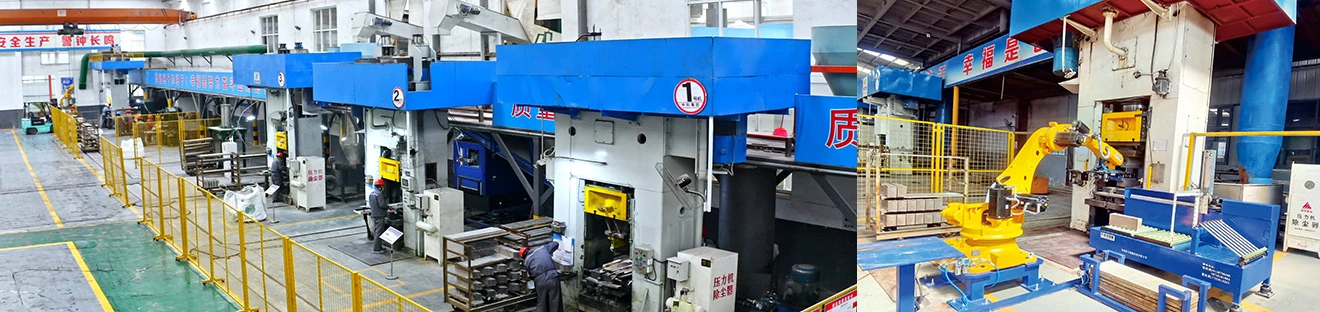
Formulations are batched by computer to the approved recipe, then pressed on 630 T to 2,500 T CNC hydraulic presses. Pressing pressure and density are controlled per shape, which is what keeps batch-to-batch variation at laboratory level.
High-temperature tunnel firing
Firing curve is specified per grade and logged. For fired bricks, the firing profile is a material property in its own right, not a processing step.
Independent laboratory testing
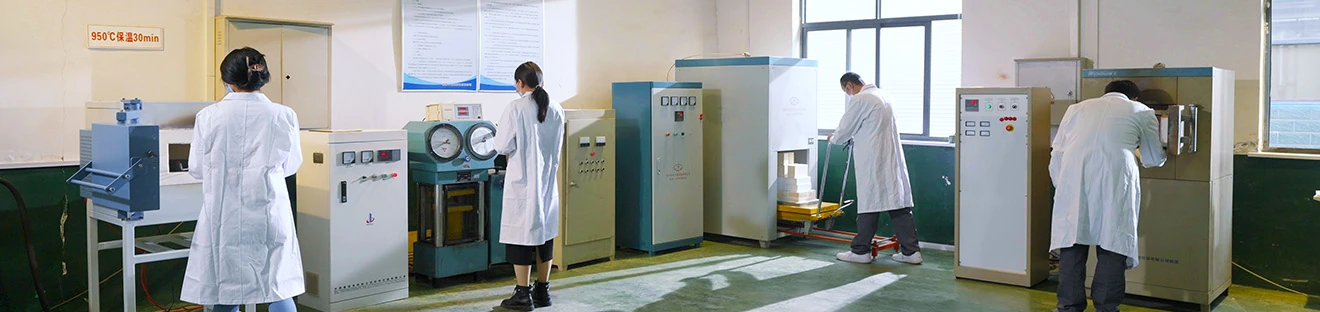
In-house laboratory testing for chemical composition, bulk density, apparent porosity, cold crushing strength, refractoriness under load, thermal expansion and hot modulus of rupture — against the figures agreed in the specification.
Dimensional and pre-assembly verification
Dimensional checking per drawing, and for complex linings a pre-assembly at the factory to verify fit and joint tolerances. The as-built record ships with the material.
Third-party inspection on request
SGS, BV or TüV pre-shipment inspection can be arranged at any stage. The batch Certificate of Analysis is issued for every shipment regardless.
Materials Already in Service Where Brand Refractories Are Used
The most useful evidence is not a claim about quality, it is the list of plants already running our material. Our metals-industry client base includes integrated producers, mini-mills and rolling groups in East Asia, South Asia, the CIS, the Middle East, North Africa and South America — among them Hyundai Steel, JSW, Severstal, MMK, Tata Steel, Baosteel, Shougang and Colakoglu. We have supplied into plants where international-brand refractories are also in use, which means the material has been evaluated against the same operating conditions and acceptance standards.
How to Switch Suppliers Without Taking the Risk
Most failed supplier switches fail for the same reason: the change is made at full scale, on a critical vessel, against a deadline. The method below is what we recommend instead, and it is deliberately cautious.
- Step 1 — Specification comparison, not a quotation. Send the data sheet for the product you currently use. We respond in writing with the achievable figures, stating clearly where a property cannot be matched. This costs nothing and tells you immediately whether the switch is worth pursuing.
- Step 2 — Trial batch on a non-critical zone. Order a small quantity for a zone where a failure is manageable. Run it for a defined period and compare wear against the incumbent material on an adjacent zone under the same conditions.
- Step 3 — Compare like for like. Compare cost per unit of campaign life, not cost per tonne. A material that is cheaper per tonne and wears 20% faster is not cheaper.
- Step 4 — Scale with a retained fallback. Extend to the full vessel only after the trial data supports it, and keep the previous supplier qualified for the first full campaign. If the transition goes badly, you have somewhere to go back to.
- Step 5 — Fix the specification, not the supplier. Once a grade performs, put the figures in writing as an incoming acceptance specification with batch COA against it. That protects you regardless of who supplies next.
Why we publish this. The largest cost of switching is the risk of a bad first order, and the largest cause of a bad first order is moving too fast on a critical vessel. A trial batch costs very little and removes most of that risk. We would rather take a smaller first order that works than a large one that fails.
What a First Order Looks Like
Send the specification you want matched, the vessel and zone it is for, and the quantity you would take on a trial. You receive a written property comparison against your current material, a quotation for the trial quantity, and a stated lead time. Batch test data and a Certificate of Analysis come with the shipment, and third-party inspection can be arranged if your internal process requires it. If the comparison shows that a figure cannot be matched, we will say so before you order rather than after.