Electric Arc Furnace (EAF) Lining Solution

1650 °C – 1750 °C (arc radiation to 1750 °C locally at hot spots) Extended Campaign Life with Balanced Wear & Reduced Maintenance

Primary Wear & Corrosion Factors: Arc radiation at hot spots, foaming slag chemistry, scrap impact, oxidation at the slag line, thermal cycling on power-off

XZK Group provides integrated refractory packages engineered for zoned thermal and chemical stress. Every brick shape, mortar joint, and castable density is calibrated to ensure balanced refractory erosion and synchronized campaign shutdown schedules.

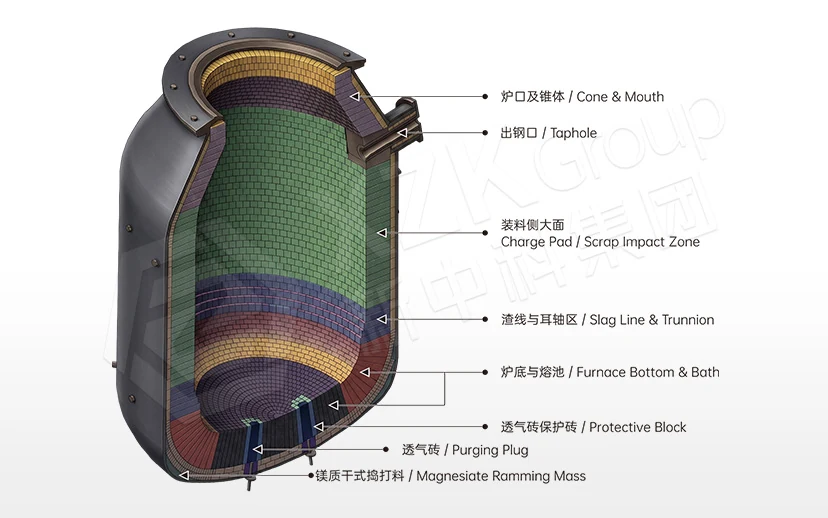
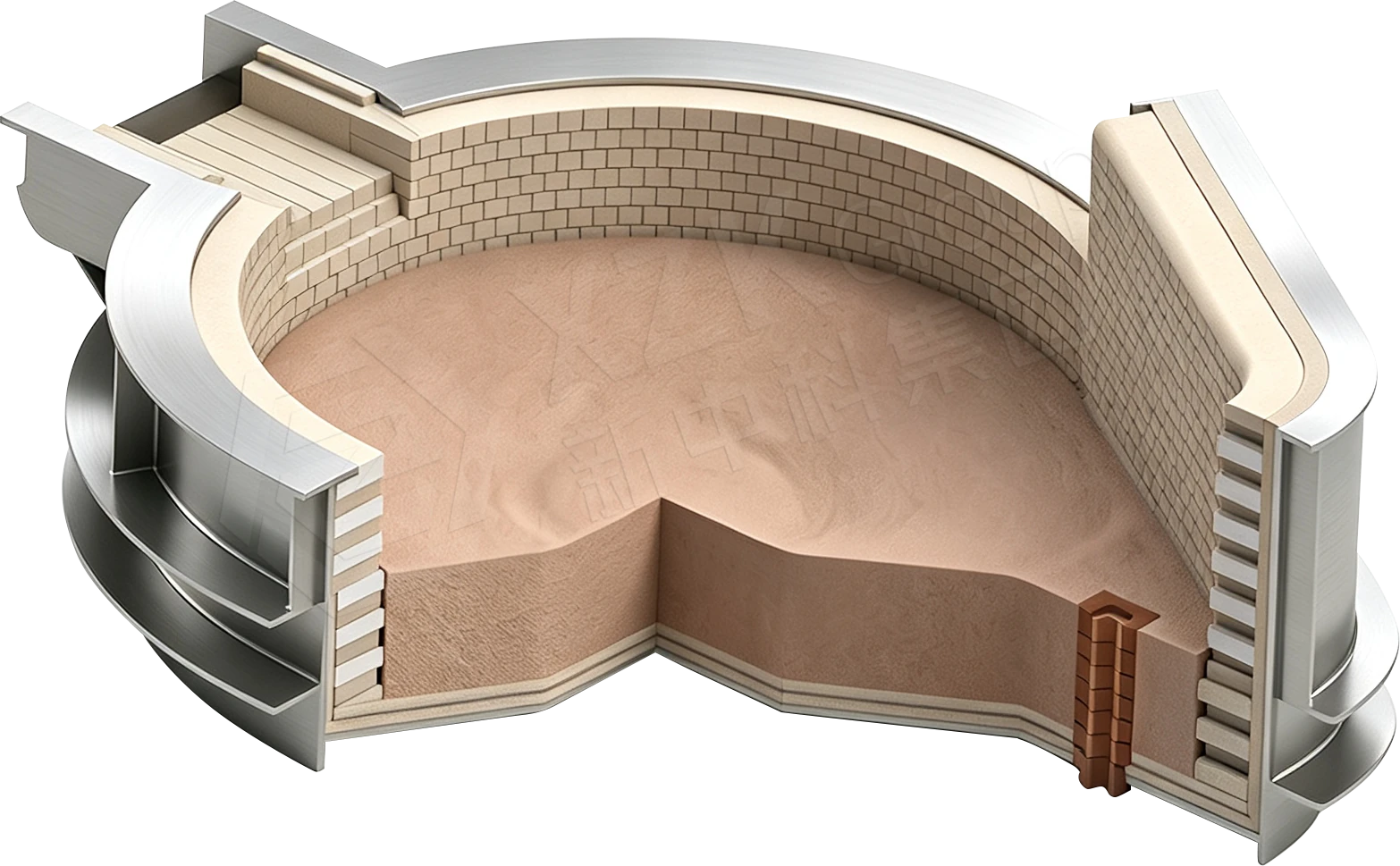
Electric Arc Furnace (EAF) Lining Solution 3D Cutaway
Tap any numbered zone to highlight the corresponding refractory grade below.
<> <> <> <>

Electric Arc Furnace (EAF) Lining Solution: Refractory Bill of Materials

Zoned lining design targeting synchronized campaign wear across all operational furnace zones. Click a hotspot above to highlight a row here.

# Furnace Lining Zone XZK Recommended Refractory Grade Key Physical & Chemical Properties Operational Mechanism & Benefits 操作
1 Hot Spots & Slag Line Resin-Bonded Fused MgO-C Bricks (XZK-MC-12AF2/F3) MgO ≥79%, C 13%, BD ≥3.07 g/cm³, CCS ≥48 MPa Withstands intense localized plasma arc radiation and foaming slag. Quote
2 EAF Delta Roof High-Alumina Chrome Castable (XZK-CastE85) Al₂O₃ ≥85%, Cr₂O₃ 2~5%, Service Temp ≤1750°C, CCS ≥40 MPa Excellent thermal shock resistance under intense arc thermal cycles. Quote
3 Furnace Hearth Magnesia Dry Ramming Mass (XZK-ERam-80) MgO ≥80%, Bulk Density ≥2.20 g/cm³, Sintering Temp 1500°C Dense self-sintering working layer provides superior molten steel sealing. Quote
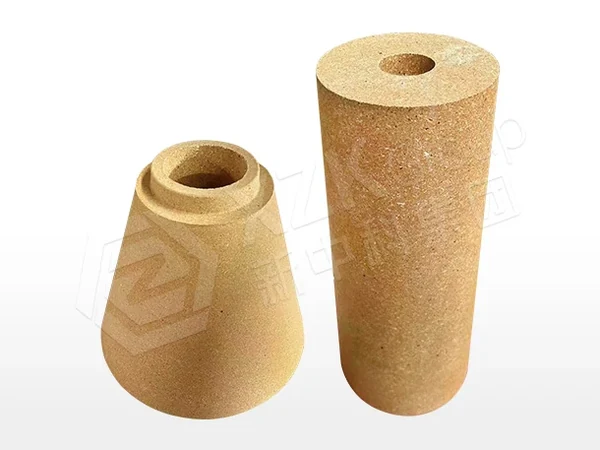
4 EBT Eccentric Bottom Taphole EBT Sleeve (XZK-MC-12AF1) & End Brick (XZK-ASC-16F1) Al₂O₃ 73%, C 17%, BD 3.10 g/cm³, High wear resistance Guarantees vortex-free slag-free tapping into steel ladle. Quote

Three Zones Consume Most of the Refractory

In an electric arc furnace, roughly 70% of lining consumption concentrates in three places, and each needs a different material:

  • Hot spots — the wall areas directly under the electrodes, exposed to intense localised radiation. XZK-MC-12AF2/F3 or 14AF2/F3, selected on power level and arc length.
  • Slag line — foaming slag chemistry attack combined with oxidation. Higher-carbon MgO-C grades with an appropriate antioxidant package.
  • Roof delta — rapid thermal cycling as the roof swings and the arc strikes. Chrome-bearing high-alumina castable (XZK-CastE85) or precast delta sections.

Hearth and Ramming

Magnesia dry ramming mass (XZK-ERam-80) forms the working hearth. It is installed dry and sinters in service, and the value is in the sintering gradient: a dense, strong sintered face with a partly unsintered, compliant layer behind it. Without that gradient the whole layer sinters, becomes rigid, and cracks as the hearth expands.

Installation discipline — layer thickness, compaction between layers, and a controlled first-heat ramp — determines hearth life more than the material specification does.

EBT and Tapping

The eccentric bottom taphole assembly is a frequent bottleneck. It needs a matched set: taphole seating and sleeve blocks in MgO-C, and ASC end blocks where the Al₂O₃-SiC-C combination handles the erosion and thermal load. Waterless clay is used for the tapping channel and EBT filler.

Maintenance

Magnesia gunning mix repairs hot spots and the slag line between campaigns, including hot gunning during short power-off windows. Rebound is usually a mismatch between mix grading and gunning equipment rather than a product defect — give us the machine make and model and we will grade the mix to suit.

What to Send Us

Furnace type (AC, DC or shaft), capacity, transformer power, scrap mix, slag practice, tap-to-tap time and current campaign life with the controlling zone. We will return a zonal material schedule covering wall, slag line, hearth, roof and EBT.
The XZK Solution — How We Engineer Campaign Life

XZK delivers precise zonal lining packages for Electric Arc Furnace (EAF) Lining Solution. Every grade in the matrix above is calibrated against three engineering levers: heat-flow management, chemical resistance, and mechanical anchoring. By tuning these three levers, we extend campaign length while keeping total refractory consumption per ton of steel competitive.

Our chief engineer Professor Shi Gan oversees every lining proposal — heat balance calculation, brick sequence optimization, and pre-assembly tolerance verification are all performed in-house before any shipment leaves Xinmi. The result: lining campaigns that match or beat OEM schedules with measurable per-ton savings.

  • Heat-flow modeling: skull/slag-layer thickness predicted for each zone
  • Chemical compatibility: brick-slag-metal reaction tests against your specific slag chemistry
  • Mechanical fit: ≤ 1 mm joint tolerance verified at CNC pressing stage
  • Pre-assembly: critical shapes pre-stacked in Xinmi for on-site fit verification
15+ Years BF campaign
150K+ MT Torpedo throughput
10K+ Heats BOF campaign
120+ Heats Ladle lining

Selected Project References

Verified deliveries to leading steel groups across Asia, Europe and the Americas.

Send Your Electric Arc Furnace (EAF) Lining Solution Drawings for a 48h Custom Lining Proposal

Our chief technical experts calculate exact brick count, radial cuts, mortar joint volumes, and castable expansion gaps. We provide comprehensive lining schematics and refractory consumption guarantees.

FAQs — Electric Arc Furnace (EAF) Lining Solution Refractories

Click to expand answers from our senior metallurgical engineers.

Which EAF zones see the highest refractory wear? +

Three zones account for over 70% of EAF lining consumption: the hot spots (directly under the three electrodes — extreme localized radiation), the slag line (foaming slag chemistry attack) and the delta roof (rapid thermal cycling during arc strikes). Each requires a different grade: XZK-MC-12AF2/F3 for hot spots, chrome-alumina castable XZK-CastE85 for the delta roof.

What makes a reliable EBT (eccentric bottom taphole)? +

A reliable EBT needs three things: tight sleeve joints (we recommend 0.5 mm tolerance), alumina-carbon material grade that resists both vortex erosion and thermal shock, and proper sand filling during operation. Our XZK-ASC-16F1 end brick combined with XZK-MC-12AF1 sleeve gives vortex-free tapping without slag carry-over.

How is water-cooled EAF delta roof different from refractories? +

For AC EAF delta roofs we still recommend our chrome-alumina castable (XZK-CastE85) — it withstands the heat radiated from the electrode arc better than water panels alone and prevents costly arc flash-through events. For DC EAF with bottom electrode, the hearth design is critical and we provide full CAD layout drawings.

Strict ISO 9001 Process Control Across All 6 Workshops

Every batch of raw materials is chemically assayed. Finished refractory shapes undergo density, ultrasonic non-destructive testing, and pre-assembly gap verification prior to global packaging.

  • Raw material ICP chemical assay on every incoming batch
  • Density, porosity and cold crushing (CCS) tests per ASTM / ISO
  • Ultrasonic non-destructive testing of finished shapes
  • Pre-assembly gap verification before seaworthy packaging
100,000+ Metric Tons Annual Capacity
60+ Countries Export Footprint
6 Fully-Equipped Workshops
100% ISO 9001:2015 Certified
Request Quote