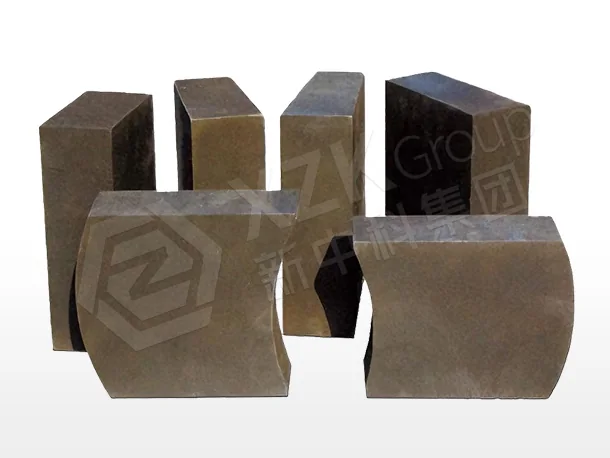
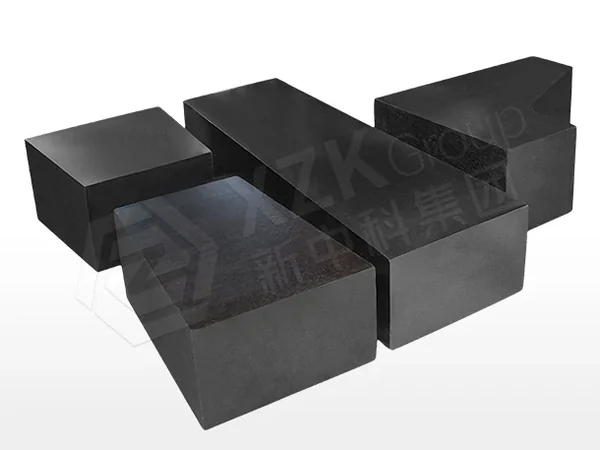
Alumina-Magnesia Carbon Brick (AMC) for Steel Ladle Sidewalls & Bottoms
Al₂O₃ 50–55% · MgO ≥25% · C 11% · BD ≥3.10–3.20 g/cm³ · CCS ≥55–60 MPa — spinel-forming ladle grades that seal joints at working temperature.
Specifications of XZK Alumina-Magnesia Carbon Brick
Manufactured strictly in accordance with ASTM, ISO, and YB/T metallurgical refractory standards.
| Location | Brand | C (%) | MgO (%) | Al₂O₃ (%) | Apparent Porosity (%) ≤ | Bulk Density (g/cm³) ≥ | Cold Crushing Strength (MPa) ≥ |
|---|---|---|---|---|---|---|---|
| Slag Line | XZK-AMC-10AF2 | 11 | 25 | 55 | 5.0 | 3.20 | 60 |
| Slag Line | XZK-AMC-10AS | 11 | 25 | 50 | 6.0 | 3.10 | 55 |
| Sidewall | XZK-AMC-10AFS | 11 | 25 | 52 | 5.5 | 3.15 | 55 |
| Sidewall | XZK-AMC-10ASF | 11 | 25 | 50 | 6.0 | 3.10 | 55 |
| Bottom | XZK-AMC-10AF2 | 11 | 25 | 55 | 5.0 | 3.20 | 60 |
| Bottom | XZK-AMC-10AS | 11 | 25 | 50 | 6.0 | 3.05 | 50 |
| Property Reported Above | ASTM | ISO | GB/T |
|---|---|---|---|
| Chemical composition — MgO, CaO, SiO₂, Fe₂O₃, Al₂O₃ | ASTM C574 | ISO 12677 | GB/T 5069 |
| Carbon / SiC content (carbon-bearing grades) | ASTM C571 | — | GB/T 17732 |
| Apparent porosity and bulk density | ASTM C20 | ISO 5017 | GB/T 2997 |
| Cold crushing strength | ASTM C133 | ISO 10059-1 | GB/T 5072 |
About XZK Alumina-Magnesia Carbon Brick
Alumina-magnesia carbon brick (AMC) is the material that made modern long-life ladle barrels practical. Its defining behaviour is not corrosion resistance — it is expansion. At working temperature the alumina and magnesia in the matrix react to form magnesium aluminate spinel (MgAl₂O₄), and that reaction is accompanied by roughly 1.5–2% permanent volumetric expansion. In a masonry lining, that is exactly what you want: it closes the joints.
Why Joints, Not Chemistry, Usually End a Ladle Campaign
A ladle lining contains hundreds of brick joints, and they are the path of least resistance. Without expansion, joints stay open through thermal cycling; molten steel and slag wick into them, forming fins that make deskulling harder and accelerate wear from the joint inward. Most ladle barrels that "failed by corrosion" actually failed by joint penetration first.
AMC addresses this mechanically rather than chemically. The spinel reaction is intrinsic to the composition, so the lining seals itself during the first heats — no additive, no special installation step. This is why AMC barrels commonly outlast denser, more corrosion-resistant materials that do not expand.
Where AMC Sits in the Ladle
- Barrel and metal line — the primary AMC zone. Joint sealing and steel-penetration resistance dominate, and carbon pickup is a secondary concern.
- Bottom and impact pad — higher density (to 3.20 g/cm³) and crushing strength (to 60 MPa) grades handle scrap charging loads and skull removal.
- Transition courses — between the MgO-C slag line and a carbon-free working lining, AMC avoids a sharp property discontinuity that would otherwise create a preferential wear path.
- Slag line on milder duties — AMC slag-line grades are available where slag basicity and FeO are moderate.
Selecting Between AMC, MAC and MgO-C
These three families are often confused because the names overlap. The practical distinction is chemistry direction:
- AMC — alumina-rich (50–55% Al₂O₃, ~25% MgO). Expands, seals joints. Barrel and bottom.
- MAC — magnesia-rich (52–54% MgO, ~25% Al₂O₃). Also spinel-forming, but with a magnesia-dominant matrix, used as a transition grade.
- MgO-C — magnesia-only (72–89% MgO) with 4–19% carbon. Maximum slag corrosion resistance. Slag line and metal zone.
Running one of these through the whole vessel is the most common specification error we see, because it guarantees that whichever zone is harshest dictates the reline date.
Carbon Pickup: The Real Constraint
At 11% carbon, AMC is gentler on steel chemistry than a 14–18% MgO-C grade, but it is not carbon-free. For ultra-low-carbon, IF and other carbon-critical grades, the working lining should be a carbon-free corundum-spinel castable, with AMC or MgO-C confined to zones where steel does not dwell. Tell us your carbon ceiling and route, and we will place the boundary correctly.
Manufacturing and Quality Control
XZK AMC bricks are pressed on 2,000-ton class CNC hydraulic presses from automatically weighed batches and tempered under controlled atmosphere. Bulk density, apparent porosity and cold crushing strength are tested per batch per ASTM C830 and C133, and a Certificate of Analysis ships with every lot. Matching corundum-spinel well blocks and purging plug seats are supplied as a set with the nozzle interface machined to your mechanism. Send your ladle drawing and route for a zone-by-zone grade map within 48 hours.
Where This Grade Sits in the Lining System
Carbon-bonded basic grades are never specified in isolation. Carbon level, antioxidant package and bulk density are all set by the zone, and the zone map is set by the vessel — which is why a grade that performs well in one position can fail early in the next.
XZK supplies alumina-magnesia carbon brick as one zone of a zoned package rather than as a standalone item: the grades normally zoned alongside it — among them magnesia carbon brick — are documented on the magnesia-carbon and basic refractories page, and the vessel-level architecture — where each zone starts and ends, and which mechanism actually limits the campaign — is set out on the steel ladle and RH/VD page.
The JFE Steel RH degasser snorkel and ladle flow control programme reference documents how this class of material performed in full service, with the measured campaign figures rather than datasheet values.
Advantages of Choosing XZK Alumina-Magnesia Carbon Brick
In-Situ Spinel Formation
At working temperature the alumina and magnesia in the matrix react to form MgAl₂O₄ spinel, generating 1.5–2% micro-expansion that closes joints and blocks molten steel penetration — the dominant failure route in ladle sidewalls.
Lower Carbon than Slag-Line MgO-C
At 11% carbon, AMC grades limit carbon pickup into the steel while retaining enough graphite for non-wetting behaviour and thermal shock tolerance — the balance point for barrel and bottom zones on LF, RH and VD routes.
High Density and Crushing Strength
Bulk density reaches 3.20 g/cm³ with cold crushing strength to 60 MPa, giving the mechanical reserve needed at the ladle bottom where scrap charging and skull removal impose impact loading.
Extends the Whole Ladle, Not Just One Zone
Because AMC sidewalls and bottoms wear at a rate closer to the MgO-C slag line, the vessel stops being relined on its weakest single zone — which is where most ladle refractory cost is actually lost.
Specific Applications of Alumina-Magnesia Carbon Brick
Proven performance across diverse heavy industrial thermal equipment.
Steel Ladle Sidewall
Barrel and metal-line zones on LF, RH, VD and CAS-OB routes, where joint sealing and resistance to steel penetration matter more than maximum slag corrosion resistance.
Steel Ladle Bottom
Bottom and impact-pad zones requiring high density and crushing strength, including grades paired with purging plug well blocks and seat bricks.
Transition Zones
Used between the MgO-C slag line and the carbon-free working lining where a sharp property discontinuity would otherwise create a stress concentration and a preferential wear path.
400+ Furnaces Trust XZK Refractory Solutions
Over 75% of our international steel and kiln clients continue multi-year long-term procurement partnerships.
The AMC sidewalls expanded enough at working temperature that our joint penetration problem effectively disappeared. We stopped finding steel fins between courses at deskulling.
Density and crushing strength were both at the top of the range on every batch we tested. Bottom life now matches the slag line instead of being the reason we come down early.
We run LF and RH on the same ladles, so we needed a grade that would not pick up carbon but still handle thermal cycling. This was the right compromise.
Delivery was sequenced by zone, which cut our reline time. Every pallet was labelled to the drawing.
Frequently Asked Engineering Questions
Click any question to expand; only one answer is shown at a time.
How is AMC different from MgO-C brick?
AMC (alumina-magnesia-carbon) is alumina-rich with around 25% MgO and forms spinel at working temperature, producing micro-expansion that seals joints. MgO-C is magnesia-rich (72–89% MgO) and is selected for maximum slag corrosion resistance. In practice AMC goes in the ladle barrel and bottom, MgO-C goes in the slag line.
Why does the micro-expansion matter?
A ladle lining is a masonry structure with hundreds of joints. Without expansion the joints stay open, and molten steel and slag penetrate between courses, forming fins and accelerating wear. The 1.5–2% spinel-driven expansion closes those joints in service, which is why AMC barrels often outlast plain high-alumina or fireclay alternatives by a wide margin.
Can AMC be used at the slag line?
It can on milder duties, and we do supply AMC slag-line grades. But where slag basicity and FeO are high, MgO-C with a proper antioxidant package will normally give longer life. We would rather specify the right material for each zone than sell one grade for the whole vessel.
What carbon pickup risk does AMC carry?
At 11% carbon it is lower than a 14–18% MgO-C grade but not zero. For ultra-low-carbon and IF steels, the safest route is a carbon-free corundum-spinel castable working lining, with AMC or MgO-C confined to zones where the steel does not dwell.
What is the typical service life?
That depends far more on your ladle route, slag chemistry and preheat practice than on the brick alone. Rather than quote a generic number, we review your operating data and project residual thickness per zone — and we will tell you honestly if AMC is not the right call for a particular zone.
Do you supply matching well blocks and purging seats?
Yes. AMC barrels are normally paired with corundum-spinel well blocks and purging plug seat bricks, supplied as a matched set with the nozzle interface machined to your mechanism.
What is the MOQ and lead time?
10 metric tons for standard grades shipping in 7–14 days; 20 metric tons for custom zonal packages and special shapes in 20–35 days including tooling.
How are the bricks packed and how long do they keep?
Palletised at 1.0–1.2 metric tons on ISPM-15 fumigated pallets with PE wrap, edge protectors and a moisture-barrier liner. Every pallet is date-stamped; shelf life is six months in original sealed packaging, stored dry, under cover and below 40 °C.
Related Refractories & Lining Materials
Explore complementary refractory brick grades and monolithic materials for your furnace relining.
Get Your Alumina-Magnesia Carbon Brick Quote within 12 Hours
Please specify your refractory requirements by referring to the following aspects:
- ✓ Target Application: Furnace type, lining position (slag line, hearth, roof)
- ✓ Technical Specs: Operating temperature, slag chemistry, chemistry requirements
- ✓ Quantity & Dimensions: Tonnage requirement, standard or custom CAD drawing
- ✓ Delivery Terms: FOB Qingdao/Tianjin, CIF destination port
Why Steel Plants Choose XZK Refractories
Zonal Engineering, Not Just Bricks
Every proposal is a zone-by-zone material schedule matched to your furnace profile and operating practice — so all zones reach end-of-life together.
Source Factory Consistency
Fully automatic CNC batching and zero-defect quality control keep batch-to-batch variation at laboratory level.
Proven Global References
Supplied to Baosteel, Shougang, Hyundai Steel, JSW, Severstal, MMK and 400+ furnace projects across 60+ countries.
Full-Lifecycle Service
Lining design, masonry supervision, heat-up curves and failure analysis — plus EPC turnkey delivery for new builds and relines.
Send Us Your Furnace Drawing
Our engineers will return a zonal lining proposal with material schedule and quotation within 48 hours — even for non-standard shapes.
- Free material feasibility review
- Zonal architecture & installation drawings
- Heat-up curve & masonry guidance
Strict ISO 9001 Process Control Across All 6 Workshops
Every batch of raw materials is chemically assayed. Finished refractory shapes undergo density, ultrasonic non-destructive testing, and pre-assembly gap verification prior to global packaging.
- Raw material ICP chemical assay on every incoming batch
- Density, porosity and cold crushing (CCS) tests per ASTM / ISO
- Ultrasonic non-destructive testing of finished shapes
- Pre-assembly gap verification before seaworthy packaging