BOF Basic Oxygen Converter Refractory Solution

1650 °C – 1750 °C (combined blowing, slag splashing maintenance) 10,000+ Heats with Combined Blowing & Slag Splashing Maintenance

Primary Wear & Corrosion Factors: FeO-rich hyper-basic slag dissolution, oxygen jet turbulence, scrap impact at the charge pad, thermal cycling, carbon oxidation

XZK Group provides integrated refractory packages engineered for zoned thermal and chemical stress. Every brick shape, mortar joint, and castable density is calibrated to ensure balanced refractory erosion and synchronized campaign shutdown schedules.

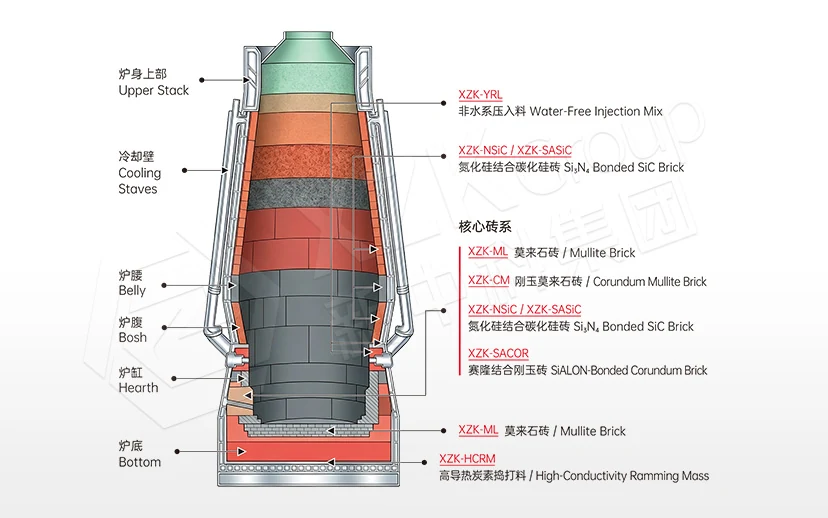
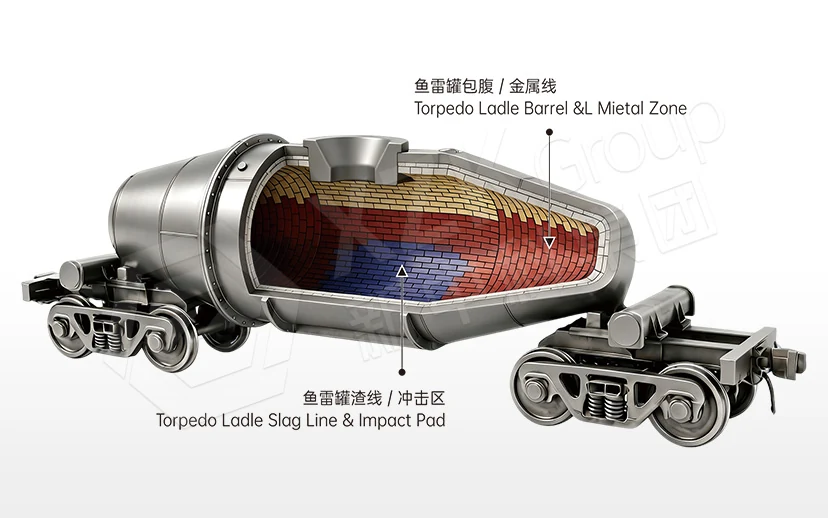
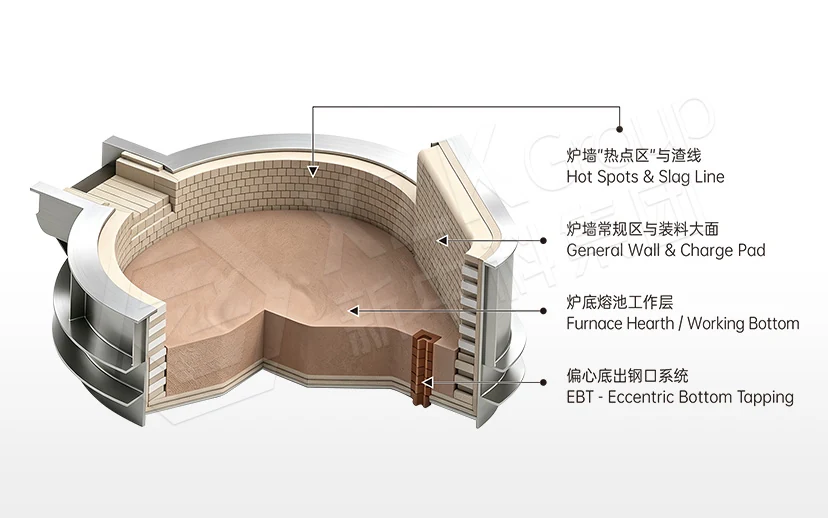
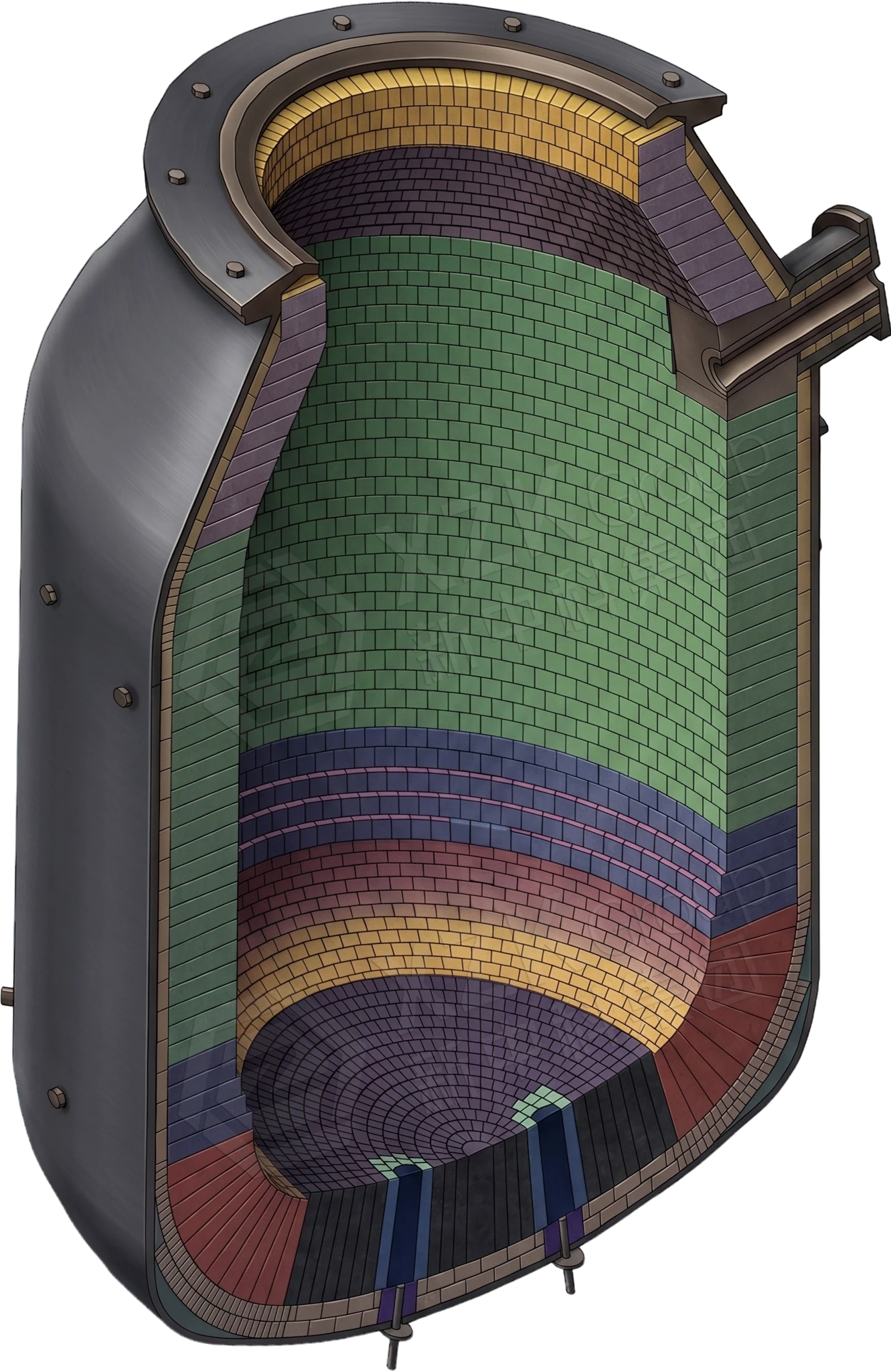
BOF Basic Oxygen Converter Refractory Solution 3D Cutaway
Tap any numbered zone to highlight the corresponding refractory grade below.
<> <> <> <>

BOF Basic Oxygen Converter Refractory Solution: Refractory Bill of Materials

Zoned lining design targeting synchronized campaign wear across all operational furnace zones. Click a hotspot above to highlight a row here.

# Furnace Lining Zone XZK Recommended Refractory Grade Key Physical & Chemical Properties Operational Mechanism & Benefits 操作
1 Slag Line & Trunnion High-Purity Fused Magnesia Carbon Brick (XZK-MC-14AF1/F2) MgO ≥77%, C 15%, BD ≥3.05 g/cm³, HMOR (1400°C) ≥14 MPa Superior chemical resistance to hyper-basic FeO-rich converter slags. Quote
2 Cone & Upper Mouth Anti-Spalling Magnesia Carbon Brick (XZK-MC-14AF3) MgO ≥76%, C 15%, BD ≥3.05 g/cm³, CCS ≥43 MPa Resists scrap impact, thermal spalling during tilting, and slag build-up chipping. Quote
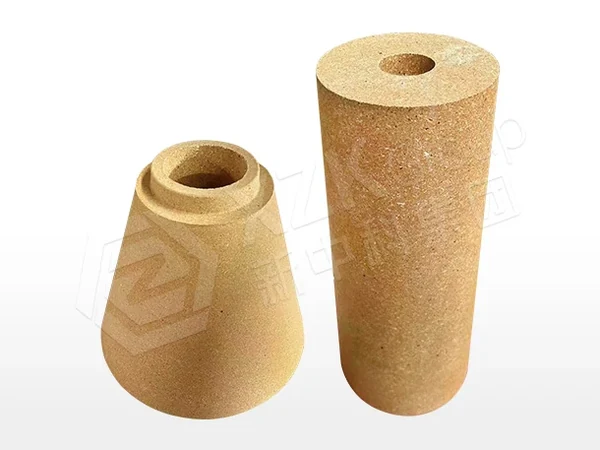
3 Bottom & Purging Plugs Dense Magnesia Carbon Brick (XZK-MC-14AF1) MgO ≥77%, C 15%, High hot modulus of rupture Provides stable multi-hole argon blowing channels for efficient combined blowing. Quote
4 Taphole Sleeve & Seating High-Density Magnesia Carbon (XZK-MC-12AF1/F2) MgO ≥79%, C 13%, BD ≥3.05 g/cm³, HMOR ≥14 MPa Clean steel tapping flow control with minimal nozzle bore diameter expansion. Quote

One Vessel, Fourteen Positions

A 300 t BOF lining uses roughly fourteen distinct brick positions, and each has a different dominant failure mechanism. Lining the vessel with one grade guarantees that the harshest zone fails first and everything else is relined prematurely. That is the single largest source of avoidable refractory cost in a converter shop.

Zone by Zone

  • Charge pad and cone — scrap collapse impact dominates. Impact-resistant MgO-C grades (XZK-MC-14AF3 / 16AF3) with crushing strength ≥40 MPa, not maximum carbon.
  • Slag line and metal zone — chemical dissolution by FeO-rich, high-basicity slag (C/S ≥ 3.5). Higher carbon (14–19%) with MgO pushed to 77% and an antioxidant package matched to temperature.
  • Taphole — seating and sleeve blocks in XZK-MC-12AF1/F2, where dimensional accuracy controls tapping performance.
  • Bottom and purging — MgO-C bottom grades with matched purging plugs and protective blocks.
  • Safety lining — low-carbon XZK-MC-4F3 (4% C, 89% MgO) for steel cleanliness and low thermal conductivity.

Oxidation, Not Corrosion, Is Usually the Limiter

In most converters, carbon oxidation precedes slag attack. Once oxygen or FeO reaches the graphite, the brick loses its slag barrier, porosity climbs, and penetration accelerates. Antioxidant selection — Al and Si at lower temperatures, SiC and B₄C through 1400–1600 °C — typically buys more campaign life than simply raising carbon content.

Maintenance Between Campaigns

Magnesia gunning mix restores the slag line and charge pad between planned relines, levelling the wear profile so the vessel is not taken out on a single thin spot. Gunning is a maintenance tool, not a substitute for correct grade selection — if a zone needs gunning every few heats, that is a signal to re-grade it.

What to Send Us

Vessel capacity, blowing practice (top, bottom or combined), slag basicity and FeO, scrap practice, current campaign life and which zone controls it, plus photographs of the worn lining. We will return a zone-by-zone grade map with a consumption forecast and a projected campaign life.
The XZK Solution — How We Engineer Campaign Life

XZK delivers precise zonal lining packages for BOF Basic Oxygen Converter Refractory Solution. Every grade in the matrix above is calibrated against three engineering levers: heat-flow management, chemical resistance, and mechanical anchoring. By tuning these three levers, we extend campaign length while keeping total refractory consumption per ton of steel competitive.

Our chief engineer Professor Shi Gan oversees every lining proposal — heat balance calculation, brick sequence optimization, and pre-assembly tolerance verification are all performed in-house before any shipment leaves Xinmi. The result: lining campaigns that match or beat OEM schedules with measurable per-ton savings.

  • Heat-flow modeling: skull/slag-layer thickness predicted for each zone
  • Chemical compatibility: brick-slag-metal reaction tests against your specific slag chemistry
  • Mechanical fit: ≤ 1 mm joint tolerance verified at CNC pressing stage
  • Pre-assembly: critical shapes pre-stacked in Xinmi for on-site fit verification
15+ Years BF campaign
150K+ MT Torpedo throughput
10K+ Heats BOF campaign
120+ Heats Ladle lining

Selected Project References

Verified deliveries to leading steel groups across Asia, Europe and the Americas.

Send Your BOF Basic Oxygen Converter Refractory Solution Drawings for a 48h Custom Lining Proposal

Our chief technical experts calculate exact brick count, radial cuts, mortar joint volumes, and castable expansion gaps. We provide comprehensive lining schematics and refractory consumption guarantees.

FAQs — BOF Basic Oxygen Converter Refractory Solution Refractories

Click to expand answers from our senior metallurgical engineers.

Which MgO-C grade suits the BOF slag line best? +

The slag line carries the most extreme combination of basic slag (C/S ratio ≥ 3.5), oxygen jet scouring and thermal cycling — high-purity fused magnesia (≥97% MgO) with 14–18% flake graphite gives the right balance of oxidation resistance and chemical resilience. Our XZK-MC-14AF1/F2 series is the industry workhorse for slag-line and trunnion zones.

How does XZK address BOF bottom purging reliability? +

Bottom purging reliability starts with MgO-C brick integrity (XZK-MC-14AF1 with HMOR ≥14 MPa), but the real secret is precise installation tolerance (≤1 mm joints) and our recommended joint mortar specification. We also supply monolithic purging plug systems with 100% open-rate guarantee.

What about slag splashing as a maintenance strategy? +

Slag splashing is an excellent way to extend BOF lining life — we help mills define optimal slag chemistry and viscosity windows for their specific carbon and MgO brick grades, reducing skull accumulation and doubling lining campaigns.

Strict ISO 9001 Process Control Across All 6 Workshops

Every batch of raw materials is chemically assayed. Finished refractory shapes undergo density, ultrasonic non-destructive testing, and pre-assembly gap verification prior to global packaging.

  • Raw material ICP chemical assay on every incoming batch
  • Density, porosity and cold crushing (CCS) tests per ASTM / ISO
  • Ultrasonic non-destructive testing of finished shapes
  • Pre-assembly gap verification before seaworthy packaging
100,000+ Metric Tons Annual Capacity
60+ Countries Export Footprint
6 Fully-Equipped Workshops
100% ISO 9001:2015 Certified
Request Quote