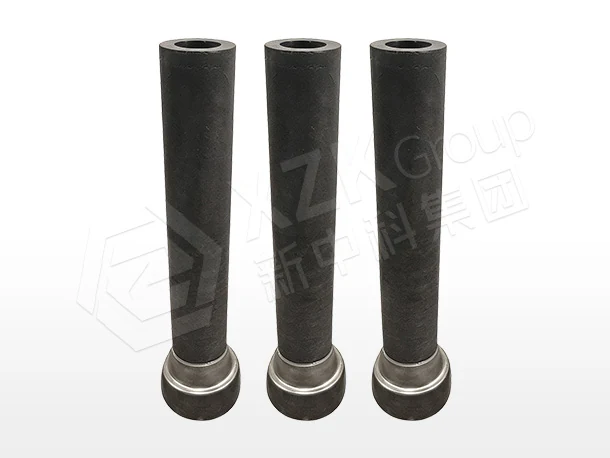
Ladle Shroud (Long Nozzle) with Zirconia Slag-Line Band for Sequence Casting
Body Al₂O₃ ≥40–45% · Slag line ZrO₂ ≥55% · C+SiC ≥22–25% · BD ≥2.25–3.00 g/cm³ · CCS ≥10–22 MPa · Thermal shock ≥5 cycles.
Specifications of XZK Ladle Shroud (Long Nozzle)
Manufactured strictly in accordance with ASTM, ISO, and YB/T metallurgical refractory standards.
| Property | XZK-CLTZ Body | XZK-CLTZ Slag Line | XZK-CLTA Body | XZK-CLTA Slag Line |
|---|---|---|---|---|
| Al₂O₃ (%) ≥ | 45.0 | — | 40.0 | 50.0 |
| SiO₂ (%) ≤ | 20.0 | — | 20.0 | 10.0 |
| C + SiC (%) ≥ | 25.0 | ≤ 18.0 | 25.0 | 22.0 |
| ZrO₂ (%) ≥ | — | 55.0 | — | — |
| Cold Crushing Strength (MPa) ≥ | 22 | 10 | 22 | 22 |
| Cold Modulus of Rupture (MPa) ≥ | 6 | 4 | 6 | 6 |
| Apparent Porosity (%) ≤ | 20.0 | 19.0 | 23.0 | 20.0 |
| Bulk Density (g/cm³) ≥ | 2.30 | 3.00 | 2.25 | 2.30 |
| Thermal Shock (1100 °C water, cycles) ≥ | 5 | 5 | 5 | 5 |
Values are typical production averages, not guaranteed minima. A batch-specific Certificate of Analysis is issued for every shipment; third-party inspection (SGS / BV / TÜV) can be arranged on request.
| Property Reported Above | ASTM | ISO | GB/T |
|---|---|---|---|
| Chemical composition — Al₂O₃, SiO₂, Fe₂O₃, TiO₂, alkali oxides | ASTM C573 | ISO 12677 | GB/T 6900 |
| Carbon / SiC content (carbon-bearing grades) | ASTM C571 | — | GB/T 17732 |
| Apparent porosity and bulk density | ASTM C20 | ISO 5017 | GB/T 2997 |
| Cold crushing strength | ASTM C133 | ISO 10059-1 | GB/T 5072 |
| Hot modulus of rupture (carbon-bearing grades) | ASTM C1099 | ISO 5013 | GB/T 13243 |
| Thermal shock resistance | ASTM C1171 | — | GB/T 30873 |
Every value in the tables above is determined by the method stated in this reference table, and the method is identified on the batch Certificate of Analysis. Where a property is not covered by a directly corresponding ISO method, the ASTM or GB/T method is applied as the reference method and stated accordingly. Third-party verification (SGS / BV / TÜV) can be arranged on request.
About XZK Ladle Shroud (Long Nozzle)
Ladle shrouds — also called long nozzles — do two jobs at once. Mechanically they carry the steel stream from ladle to tundish. Metallurgically they seal that stream from air, which is a steel-cleanliness function rather than a refractory one. Both matter, and they fail in different places.
Slag Band, Not Body, Ends the Shroud
On a long sequence, the body of the shroud is rarely the problem. The wear concentrates in a narrow band at the slag line, where the shroud passes through the tundish slag layer. That band dissolves, thins, and eventually the shroud has to be changed — regardless of how much body material is left.
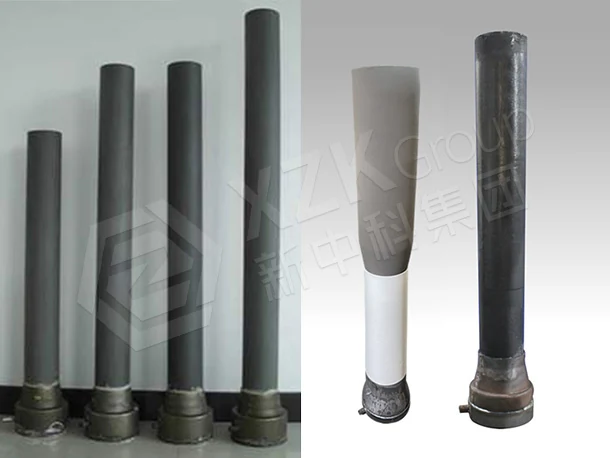
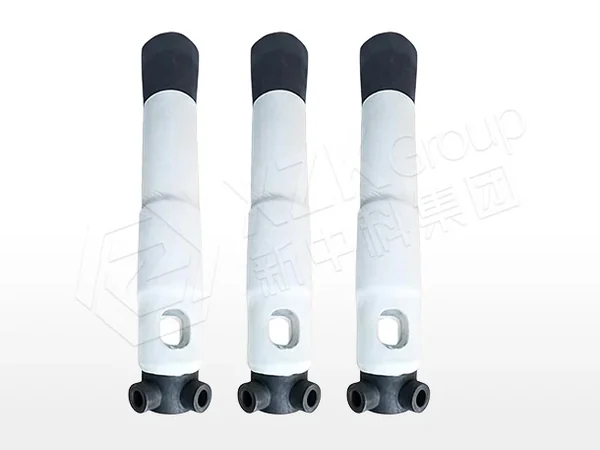
XZK-CLTZ addresses this directly with a 55% ZrO₂ band at the slag line, at 3.00 g/cm³ density, bonded into an alumina-carbon body. Zirconia resists slag-band dissolution far better than alumina-carbon, and the additional cost is normally recovered through additional heats per shroud.
Reading the Two Grades
- XZK-CLTZ — alumina-carbon body (45% Al₂O₃, CCS 22 MPa) with a zirconia slag band (ZrO₂ ≥55%). For aggressive slag and long sequences.
- XZK-CLTA — all alumina-carbon, with a higher-alumina slag-line section (50% Al₂O₃). For milder duty where a zirconia band is not justified.
Steel Quality Is Part of the Specification
An open stream absorbs nitrogen and oxygen from the air and reoxidises the steel, which shows up downstream as inclusions. Properly shrouded casting measurably reduces nitrogen pickup. If cleanliness specifications are tight at your plant, the shroud is part of the quality system — not just a consumable.
Preheat-Free
Preheat-free shrouds remove the preheat step and the thermal shock event that accompanies it. For plants running tight ladle turnaround, or without dedicated preheat capacity, this saves time per sequence and removes a common cause of start-up cracking. It is often worth more than the material price difference suggests.
Supply
Quoted per set, typically 200–500 pieces minimum, 20–35 days from drawing approval. Lengths, bore profiles and band position are made to drawing so the shroud fits your ladle-to-tundish geometry. Dimensional inspection reports and batch test data ship with every order.
Where This Grade Sits in the Lining System
Flow-control refractories are consumed on the caster's schedule, so the specification is as much about dimensional repeatability and interchangeability with your existing mechanism as it is about composition. A plate or shroud that fits but varies by a millimetre between lots costs more in breakouts than it saves in unit price.
XZK supplies ladle shroud (long nozzle) as one zone of a zoned package rather than as a standalone item: the grades normally zoned alongside it — among them monobloc stopper rod — are documented on the continuous casting functional refractories page, and the vessel-level architecture — where each zone starts and ends, and which mechanism actually limits the campaign — is set out on the tundish flow control and steel ladle and RH/VD pages.
Campaign data measured on this class of lining — including the wear profile that drove grade selection — is published in the Colakoglu Metalurji slab caster flow control programme project reference.
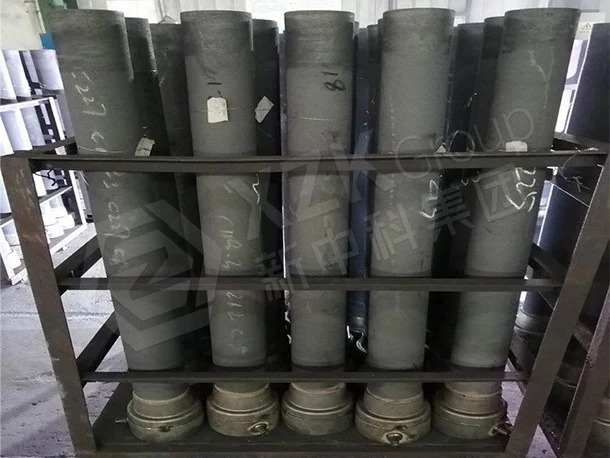
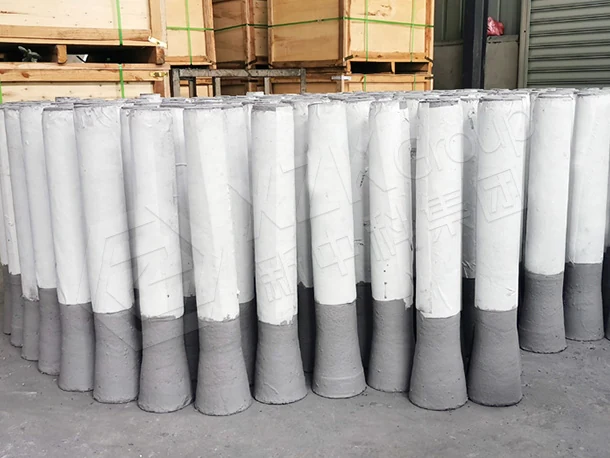
Ladle Shroud (Long Nozzle) — Production & Application Scenarios
Premium raw materials, CNC pressing, high-temp firing, and on-site installation.
Advantages of Choosing XZK Ladle Shroud (Long Nozzle)
Zirconia Band Where Slag Attacks
The slag line is the fastest-wearing part of a shroud. A 55% ZrO₂ band resists slag-band dissolution far better than the alumina-carbon body, and the extra cost is normally recovered through extended sequence length.
Protects Steel From Reoxidation
A shroud seals the stream between ladle and tundish, preventing air absorption and nitrogen pickup. This is a steel-quality function as much as a refractory one.
Preheat-Free Option
Preheat-free shrouds remove the preheat step and the thermal shock risk that comes with it, cutting turnaround on plants with tight ladle cycles.
Made to Your Geometry
Lengths, bore profiles and band position are produced to drawing so the shroud fits your ladle-to-tundish geometry rather than forcing a compromise.
Specific Applications of Ladle Shroud (Long Nozzle)
Proven performance across diverse heavy industrial thermal equipment.
Ladle to Tundish Stream Protection
Sealed pouring between ladle and tundish on slab, bloom and billet casters.
Long Sequence Casting
Multi-heat sequences where slag-band erosion, not body wear, is the limiting factor.
Fast Turnaround Plants
Operations using preheat-free designs to shorten ladle turnaround.
400+ Furnaces Trust XZK Refractory Solutions
Over 75% of our international steel and kiln clients continue multi-year long-term procurement partnerships.
Zirconia band was the change that let us extend the sequence. Slag-band wear had been the reason we stopped.
Preheat-free shrouds cut our turnaround and we stopped seeing start-up cracks.
Nitrogen pickup dropped measurably once we had a properly sealed shroud system.
Every shroud arrived to drawing with dimensional reports. No fitting issues.
Frequently Asked Engineering Questions
Click any question to expand; only one answer is shown at a time.
When is a zirconia slag-line band worth specifying?
On long sequences and on aggressive or high-manganese slags. Slag-band dissolution is usually what ends a shroud’s life, not body wear, so a 55% ZrO₂ band at that location pays for itself through additional heats per shroud.
What is the difference between XZK-CLTZ and XZK-CLTA?
CLTZ carries a zirconia slag-line band (ZrO₂ ≥55%, density 3.00 g/cm³) against an alumina-carbon body. CLTA is an all-alumina-carbon design with a higher-alumina slag-line section (50% Al₂O₃) rather than a zirconia band. CLTZ for aggressive slag and long sequences; CLTA where the duty is milder.
Do you supply preheat-free shrouds?
Yes. Preheat-free designs remove the preheat step, cutting turnaround and eliminating a common source of thermal shock damage. They suit plants with tight ladle turnaround or without dedicated preheat stations.
Why does the shroud matter for steel quality?
An unsealed stream absorbs air, which means nitrogen and oxygen pickup and reoxidation of the steel. That shows up as inclusions downstream. Shrouding is a cleanliness measure as much as a refractory component.
What is the MOQ and lead time?
Quoted per set, typically 200–500 pieces minimum, with 20–35 days lead time from drawing approval.
What documentation is provided?
Dimensional inspection reports, batch physical and chemical test data and material certificates. Third-party inspection can be arranged.
Can you match our existing shroud geometry?
Yes. Send a drawing or a sample and we will reproduce length, bore profile and band position, or propose an improvement.
How are shrouds packed?
Individually boxed with moulded protection and palletised on ISPM-15 heat-treated pallets with moisture-barrier wrapping, with desiccant available for long sea voyages.
Related Refractories & Lining Materials
Explore complementary refractory brick grades and monolithic materials for your furnace relining.
Get Your Ladle Shroud (Long Nozzle) Quote within 12 Hours
Please specify your refractory requirements by referring to the following aspects:
- ✓ Target Application: Furnace type, lining position (slag line, hearth, roof)
- ✓ Technical Specs: Operating temperature, slag chemistry, chemistry requirements
- ✓ Quantity & Dimensions: Tonnage requirement, standard or custom CAD drawing
- ✓ Delivery Terms: FOB Qingdao/Tianjin, CIF destination port
Why Steel Plants Choose XZK Refractories
Zonal Engineering, Not Just Bricks
Every proposal is a zone-by-zone material schedule matched to your furnace profile and operating practice — so all zones reach end-of-life together.
Source Factory Consistency
Fully automatic CNC batching and zero-defect quality control keep batch-to-batch variation at laboratory level.
Proven Global References
Supplied to Baosteel, Shougang, Hyundai Steel, JSW, Severstal, MMK and 400+ furnace projects across 60+ countries.
Full-Lifecycle Service
Lining design, masonry supervision, heat-up curves and failure analysis — plus EPC turnkey delivery for new builds and relines.
Send Us Your Furnace Drawing
Our engineers will return a zonal lining proposal with material schedule and quotation within 48 hours — even for non-standard shapes.
- Free material feasibility review
- Zonal architecture & installation drawings
- Heat-up curve & masonry guidance
Strict ISO 9001 Process Control Across All 6 Workshops
Every batch of raw materials is chemically assayed. Finished refractory shapes undergo density, ultrasonic non-destructive testing, and pre-assembly gap verification prior to global packaging.
- Raw material ICP chemical assay on every incoming batch
- Density, porosity and cold crushing (CCS) tests per ASTM / ISO
- Ultrasonic non-destructive testing of finished shapes
- Pre-assembly gap verification before seaworthy packaging