A steel plant buys refractories zone by zone, not as a single product. The hearth of a blast furnace fails for different reasons than a converter slag line, which fails for different reasons again than a tundish lining. Zhengzhou XZK Industrial Group supplies shaped bricks, functional continuous-casting components and monolithic materials for every one of those zones — engineered against the wear mechanism that actually applies, not sold as a generic "high-alumina brick".
We are a source factory in Xinmi, Henan — China's principal refractory production base — operating three specialised production bases under one ISO 9001:2015 quality system. Our materials are in service in blast furnaces, converters, electric furnaces, ladles and casters across 60+ countries, and we hold 90+ national patents with a 40-strong R&D team led by Prof. Shi Gan.
Zonal Refractory Systems Across the Full Steelmaking Route
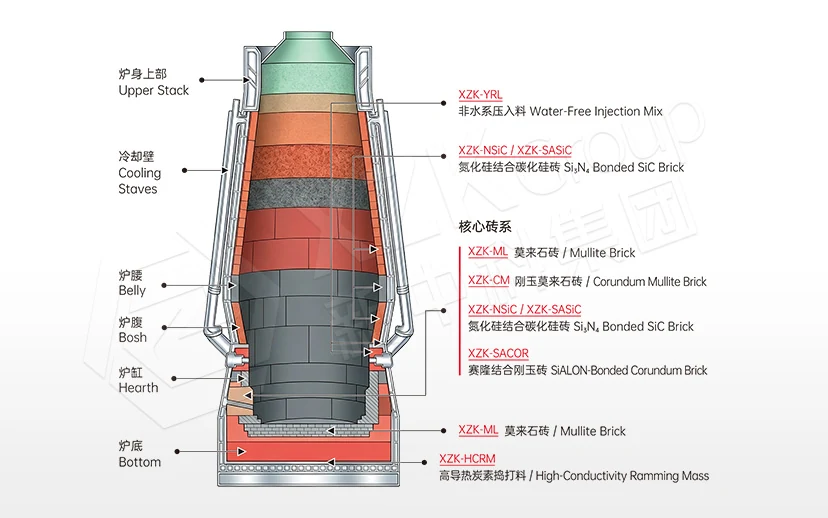
Most lining failures are not material failures. They are mismatch failures — a zone lined with a grade chosen for the wrong wear mechanism, or a lining that wears unevenly because one zone outlasts its neighbour and the campaign ends at the weakest point. The seven stages below are the ones we engineer against, and each links to the furnace-specific lining detail.
If you already know which zone is causing you trouble, go straight to that application page. If you are planning a full reline or a new build, the more useful starting point is the lining design service — we build the proposal zone by zone from your furnace drawing.
Refractory Product Range for Iron and Steel Plants
Around 250 active specifications across seven material families. The material chemistry decides which zones a grade can serve, so this is the way our range is organised rather than by furnace.
Magnesia-Carbon & Basic
High-purity fused MgO with graphite and antioxidant additions for BOF and EAF slag lines, ladle slag lines and hot-metal vessels. MgO-C, AMC and magnesia-chrome grades.
Corundum & High-Alumina
Dense corundum, corundum-mullite and low-creep high-alumina bricks for high-temperature zones where creep resistance and slag corrosion resistance govern life.
SiC & Carbon
Si₃N₄-bonded and SiALON-bonded silicon carbide, microporous carbon and ceramic cup materials — high thermal conductivity to move heat into the cooling system.
Hot Blast Stove
Low-creep andalusite, sillimanite and high-alumina checkers and dome materials engineered for zero subsidence at 1300–1450 °C blast temperatures.
Continuous Casting Functional
Slide gate plates, monobloc stopper rods, ladle shrouds, SENs, upper nozzles and purging plugs — erosion resistance balanced against anti-clogging behaviour.
Monolithic & Castables
Casthouse ASC castables, corundum-spinel and alumina-magnesia castables, dry ramming and vibratable mixes, waterless taphole clay and gunning materials.
Insulating & Backup
Alumina bubble, mullite, high-alumina and lightweight silica insulating bricks and castables that cut shell temperature and reduce the heat load the working lining has to carry.
Consumables & Hot Repair
The materials a plant buys month after month: taphole clay, gunning mix, fettling mass, filler sand, injection mix, mortar and cement. Short lead times, repeatable batches.
How We Specify a Lining: Four Decisions, in Order
The difference between a lining that reaches its design campaign and one that does not is usually made at specification stage. We work through the same four decisions on every proposal, and we will tell you when a cheaper grade will do the same job.
1 · Define the wear mechanism per zone
Slag corrosion, thermal shock, abrasion, alkali attack, oxidation or mechanical impact — a single furnace contains zones governed by different mechanisms. The material follows the mechanism, not the temperature alone.
2 · Choose the material chemistry for that mechanism
Basic chemistry against basic slag, carbon where thermal conductivity matters, silicon carbide where alkali resistance and conductivity both matter. Getting this wrong is the most common and most expensive specification error.
3 · Match wear rates across the lining
A lining fails at its weakest zone, not its average. Zones are deliberately balanced — spending on a premium grade where wear is not the limit buys nothing, while under-specifying one zone ends the campaign.
4 · Verify the joint, the fit and the heat-up curve
Joint thickness, mortar chemistry, pre-assembly tolerances and the heat-up schedule decide whether a correctly specified lining actually performs. We supply guidance for all four with the material.
The cost consequence: refractory cost per tonne of steel is driven far more by campaign life than by price per tonne of brick. A lining that lasts 15% longer at 8% higher material cost is significantly cheaper to run. We would rather help you reach that number than win a purchase order on price alone.
Wear Zone Quick Reference
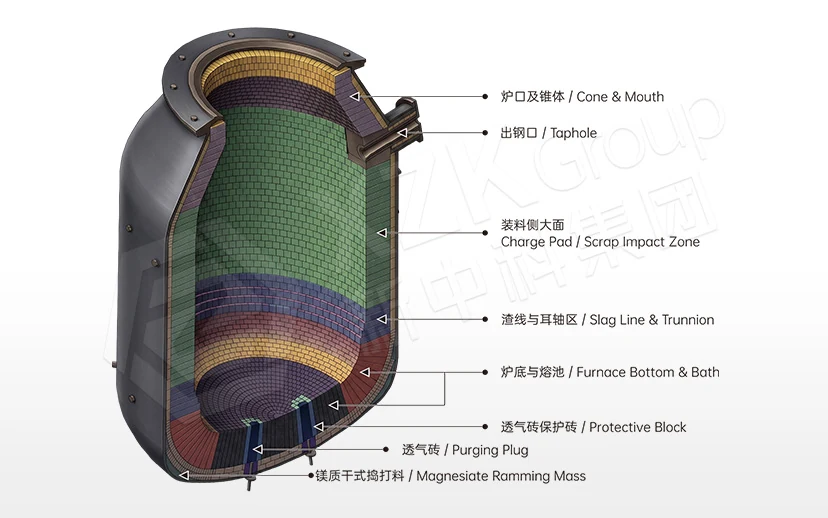
The zones below account for most of the refractories a steel plant consumes. Values are typical for the grade family, not a substitute for a specification against your own operating data.
| Furnace zone | Dominant wear mechanism | Typical grade family | Key figures to specify |
|---|---|---|---|
| BF hearth & bottom | Iron penetration, thermal load, alkali attack | Microporous carbon brick, ceramic cup, high-conductivity carbon ramming mass | Thermal conductivity ≥10–12 W/(m·K), C+SiC ≥90%, porosity |
| BF stack, bosh & belly | Alkali attack, abrasion, thermal shock | Si₃N₄-bonded SiC, SiALON-bonded corundum | SiC content, CCS, alkali resistance, hot MOR |
| Hot blast stove | Creep, subsidence, thermal cycling | Low-creep andalusite, sillimanite, high-alumina checkers | RUL (start) ≥1500–1620 °C, creep rate, PLC |
| BOF converter | Slag corrosion, oxygen blowing, charge impact | MgO-C with fused magnesia; corundum-spinel roof castables | MgO and C content, antioxidant type, HMOR, porosity |
| EAF | Arc radiation, hot spots, scrap impact | MgO-C hot spot grades, roof delta castables, dry ramming mass | MgO and C content, HMOR, thermal shock resistance |
| Steel ladle | Slag line corrosion, bottom impact, thermal cycling | AMC and MgO-C slag line, corundum-spinel castables, filler sand | MgO / Al₂O₃ content, CCS, free-opening rate for the sand |
| RH / VD degasser | Severe slag attack, thermal cycling, vacuum duty | Rebonded magnesia-chrome, direct-bonded chrome grades | Cr₂O₃ content, hot strength, thermal shock cycles |
| Tundish | Thermal shock, steel erosion, clogging | Dry vibratable mix, anti-clogging SENs, stoppers, slide gates | Bonding system, free-carbon level, anti-clogging behaviour |
| Casthouse runner | Iron and slag erosion, thermal cycling | ASC castables (Al₂O₃-SiC-C), waterless taphole clay | SiC and C content, CCS, hot strength, tapping life |
Proven in Service, Not Only in a Laboratory
Our materials are supplied into integrated steel mills, mini-mills and foundries across six continents. Reference installations include integrated producers and rolling groups in East Asia, South Asia, the CIS, the Middle East, North Africa and South America, and our metals-industry client base includes names such as Hyundai Steel, JSW, Severstal, MMK, Tata Steel, Baosteel, Shougang and Colakoglu.
Why Steelmakers Buy Direct from a Chinese Source Factory
International brands and regional trading houses both have a place, and for some programs they are the right choice. Where they are not is a well-specified lining with stable demand, where the engineering is already agreed and what remains is consistent material at a sensible cost. That is the case where buying from the factory that presses the brick is worth examining.
- No trading margin in the chain. You are buying from the party that batches, presses, fires and tests the material — which also means the technical conversation is with the people who make it.
- Full-grade coverage from one supplier. Basic, alumina, silica, carbon and monolithic families, so a complete lining can be specified and supplied as one package rather than assembled from four vendors.
- Custom shapes and compositions. Non-standard brick shapes, drawing-matched cut-to-fit pieces and composition adjustments are routine, not a special project.
- Batch test data with every shipment. A Certificate of Analysis covering the properties agreed in the specification, plus third-party inspection (SGS / BV / TÜV) on request.
- Engineering, not just supply. Zonal lining design, material schedules, masonry guidance and heat-up curves come with the order.
If you are currently buying an international brand and want to know whether a source-factory supply would hold up technically, the honest answer depends on the application. This page sets out how a switch actually works — including the trial-batch method we recommend before committing a full campaign.
Three Specification Mistakes We See Most Often
We regularly review linings that are being rebuilt earlier than planned. The cause is usually one of the three below, and none of them is a material quality problem — which is why replacing the supplier rarely fixes it.
Choosing on temperature alone
A zone at 1,700 °C under slag attack and a zone at 1,700 °C under abrasion need different materials. Specifying by temperature alone is the most common error, and it shows up as premature wear in one specific zone while the rest of the lining is still sound.
Unbalanced zone life
Spending a premium grade where wear is not the limiting factor, while under-specifying the zone that actually limits the campaign. The lining ends at its weakest point, so money spent elsewhere is lost. Balancing wear rates across zones is where campaign life comes from.
Joints treated as a site detail
Joint thickness, mortar chemistry and mixing water are often decided on site by default. A joint beyond the design thickness becomes a porous layer with poor slag resistance, and the lining then fails between the bricks rather than in them.
Testing, Documentation and Inspection
Every batch is tested against the figures agreed in the specification, and the results ship with the material. What is tested depends on the product family; the list below covers the range.
- Chemical composition — Al2O3, MgO, SiO2, SiC, C, Fe2O3, Cr2O3 and ZrO2 as applicable to the grade, by accredited methods.
- Physical properties — bulk density and apparent porosity, cold crushing strength, refractoriness under load and permanent linear change.
- High-temperature properties — hot modulus of rupture, thermal shock resistance and, for hearth carbon materials, thermal conductivity.
- Application-specific figures — creep rate for stove checkers, free-opening rate for filler sand, alkali resistance for SiC grades.
- Batch Certificate of Analysis issued for every shipment, covering the properties agreed in the specification rather than a generic data sheet.
- Third-party pre-shipment inspection by SGS, BV or TüV can be arranged at any stage, including dimensional verification and pre-assembly witnessing.
What Happens After You Send an Enquiry
Send the furnace type, the zones involved and any specifications you already have — a drawing is ideal and not essential. A senior refractory engineer reviews it, and you receive a zonal material schedule with recommended grades, quantities, key property figures and factory-direct pricing. Typical turnaround is within 12 hours for a standard vessel and 24–48 hours where a full reline schedule has to be built. If we think a different approach would serve you better, we will say so in the proposal.