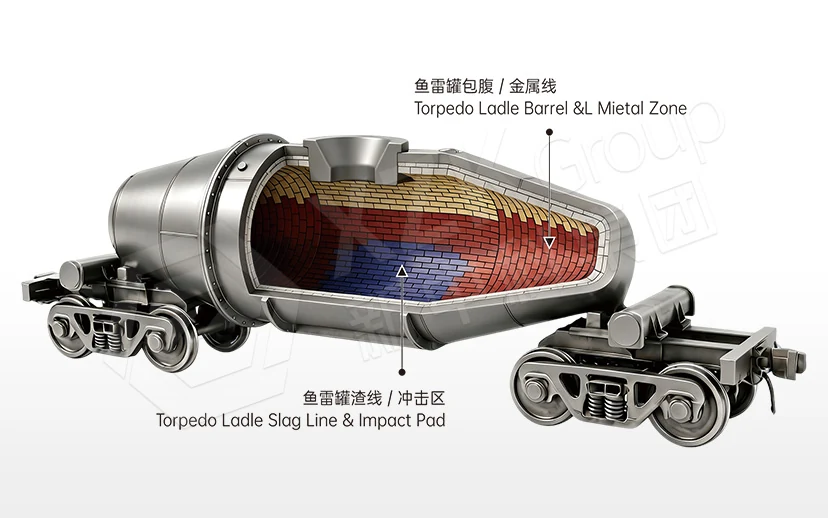
Altos Hornos de México (AHMSA) — 150 t Torpedo Car Full Refractory Package
150 t torpedo car — complete refractory supply
Primary Wear & Corrosion Factors: Refining slag dissolution at the slag line, vacuum and argon stirring scour, thermal cycling, carbon pickup risk on clean steels
XZK Group provides integrated refractory packages engineered for zoned thermal and chemical stress. Every brick shape, mortar joint, and castable density is calibrated to ensure balanced refractory erosion and synchronized campaign shutdown schedules.
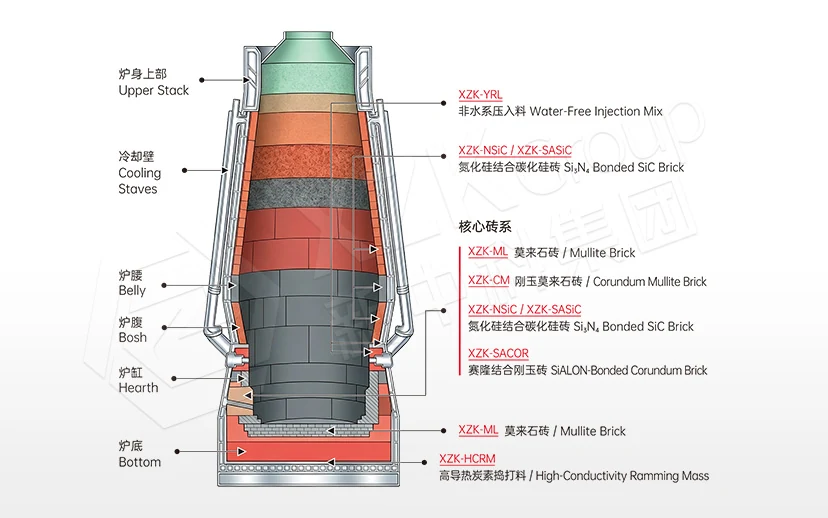
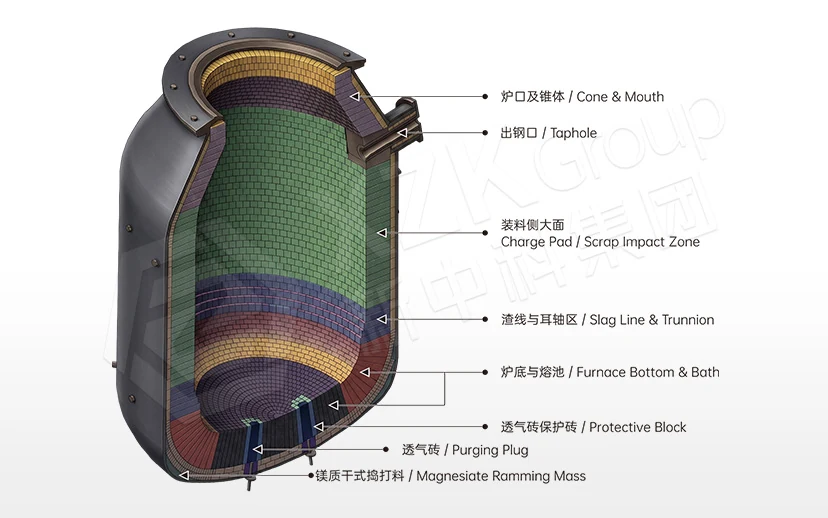
Zoned lining design targeting synchronized campaign wear across all operational furnace zones. Click a hotspot above to highlight a row here.
| # | Furnace Lining Zone | XZK Recommended Refractory Grade | Key Physical & Chemical Properties | Operational Mechanism & Benefits | 操作 |
|---|---|---|---|---|---|
| 1 | Slag Line | Low-Carbon Fused Magnesia Carbon Brick (XZK-MC-14AF1) | MgO ≥77%, C 15%, BD ≥3.05 g/cm³, HMOR ≥12 MPa | High resistance to low-basicity refining slags and arc overheating during LF reheating. | Quote |
| 2 | Ladle Sidewall & Metal Line | Alumina-Magnesia-Carbon Brick (XZK-AMC-10AFS) | Al₂O₃ ≥52%, MgO ≥25%, C 11%, BD ≥3.15 g/cm³, CCS ≥55 MPa | Spinel formation at working temperature creates micro-expansion to seal brick joints. | Quote |
| 3 | Ladle Bottom & Impact Pad | Carbon-Free Corundum Spinel Castable (XZK-CH-18ASP) | Al₂O₃ ≥90%, MgO ≥7.5%, BD ≥3.10 g/cm³, Service Temp ≤1750°C | Zero carbon pick-up for ultra-low carbon clean steel; high resistance to tapping stream impact. | Quote |
| 4 | Bottom Argon Purging Plug | Corundum-Spinel Slit-Type Purging Plug | Gas Flow Rate 10~50 Nm³/h, High anti-clogging safety | 100% reliable opening rate ensuring effective steel homogenization. | Quote |
Ladle lining specification comes down to one boundary. Carbon-bearing materials — MgO-C at the slag line, AMC in the barrel — give the longest life against refining slag. Carbon-free materials — corundum-spinel castables — protect steel chemistry on carbon-critical grades. The skill is placing that boundary correctly for your route and grade mix.
Get it wrong in either direction and you pay: too much carbon-bearing surface and you fight carbon pickup; too little and you reline prematurely.
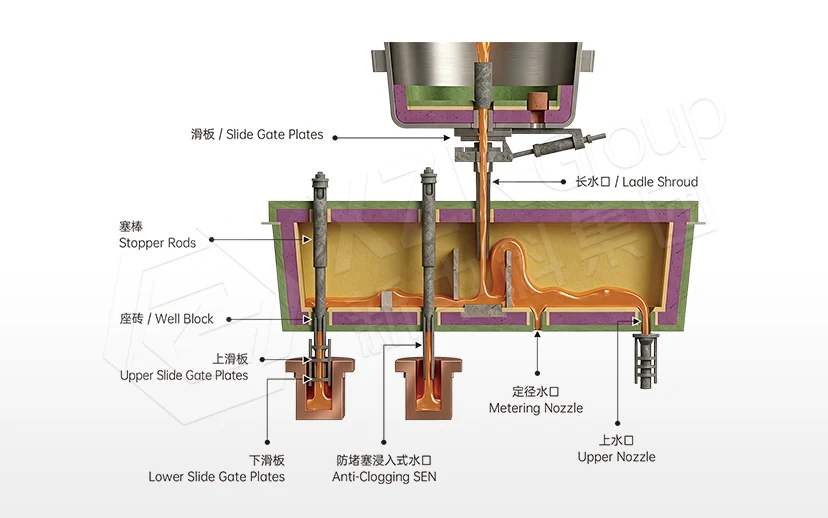
The ladle is a system, not a vessel. Slide gate plates, upper and collector nozzles, ladle shrouds and purging assemblies all have to match the route and the steel grade — and a plate chemistry mismatch or an ill-fitting well block will end the campaign regardless of how good the brick is.
Filler sand closes the loop: properly graded to nozzle bore and steel head, it is what stops a ladle arriving at the caster and refusing to open.
Ladle capacity, refining route (LF, RH, VD, CAS-OB), steel grade mix including any carbon-critical grades, slag chemistry, target campaign life and which zone currently controls it. We will return a zone-by-zone lining drawing with a material schedule and consumption forecast.
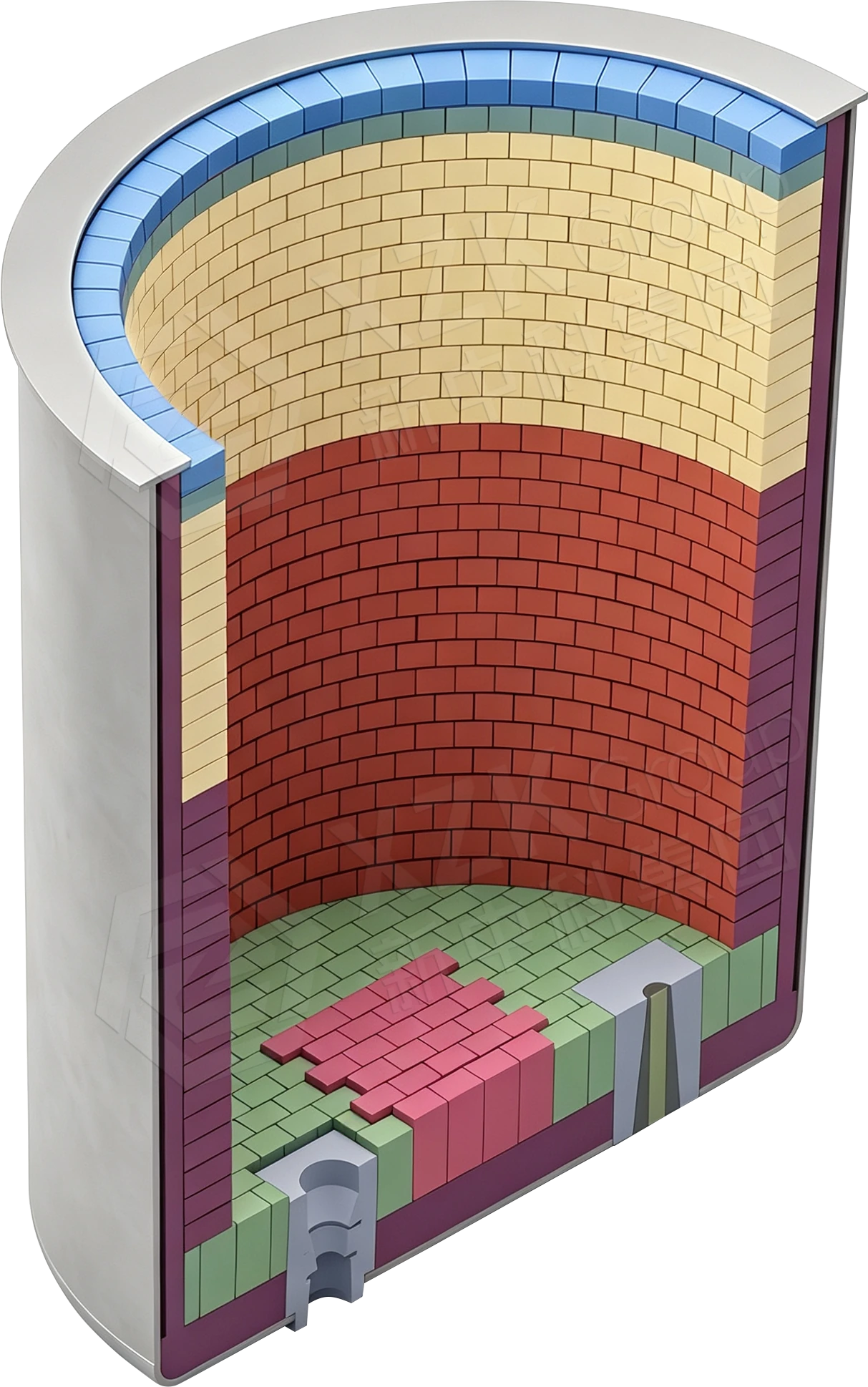
XZK delivers precise zonal lining packages for Steel Ladle & Secondary Refining Lining Solution. Every grade in the matrix above is calibrated against three engineering levers: heat-flow management, chemical resistance, and mechanical anchoring. By tuning these three levers, we extend campaign length while keeping total refractory consumption per ton of steel competitive.
Our chief engineer Professor Shi Gan oversees every lining proposal — heat balance calculation, brick sequence optimization, and pre-assembly tolerance verification are all performed in-house before any shipment leaves Xinmi. The result: lining campaigns that match or beat OEM schedules with measurable per-ton savings.
Verified deliveries to leading steel groups across Asia, Europe and the Americas.
150 t torpedo car — complete refractory supply
80–120 t EAF ladles — working lining, purging plug & well block
EAF slag line & ladle slide gate system
Click to expand answers from our senior metallurgical engineers.
Three levers move the needle: (1) correct slag-line grade — our XZK-MC-14AF1 (low-carbon fused MgO-C) is built for the harshest LF/VD/RH chemistry; (2) spinel-forming AMC sidewall bricks (XZK-AMC-10AFS) that expand at working temperature to seal joints; (3) strict preheat procedure — we provide full commissioning protocols.
AMC bricks (Alumina-Magnesia-Carbon) generate in-situ spinel (MgAl₂O₄) growth at working temperature, creating 1.5–2% micro-expansion that seals the joints and prevents steel penetration — ideal for the ladle sidewall. MgO-C bricks (especially low-carbon grades) are reserved for the slag line where basic slag chemistry attack is the dominant failure mechanism.
Use our carbon-free corundum-spinel castable XZK-CH-18ASP for the ladle bottom and impact pad — this delivers zero carbon contamination to the melt. Combine with low-carbon XZK-MC-14AF1 slag-line bricks for full ultra-low-carbon steel production.
Every batch of raw materials is chemically assayed. Finished refractory shapes undergo density, ultrasonic non-destructive testing, and pre-assembly gap verification prior to global packaging.