XZK Group exhibited at the Russian metal and metallurgy exhibition, presenting its refractory range for iron and steel production to steelmakers from Russia, the CIS and Central Asia. The stand drew engineering, procurement and maintenance visitors from integrated mills, EAF-based mini-mills and refractory trading houses — and, usefully, the conversations were technical from the first minute rather than promotional.
What We Showed
The stand was organised by application rather than by product family, so a visitor could walk the ironmaking route from blast furnace hearth to hot blast stove, then the steelmaking route from converter to caster — the same structure as our application pages. That layout choice is deliberate: it forces the conversation to start from the customer's equipment instead of our catalogue, and it makes the gaps visible. When a visitor asked about tundish working lining and we walked them from dry vibratable mix to flow control in two steps, that two-step conversation was the exhibition doing its job.
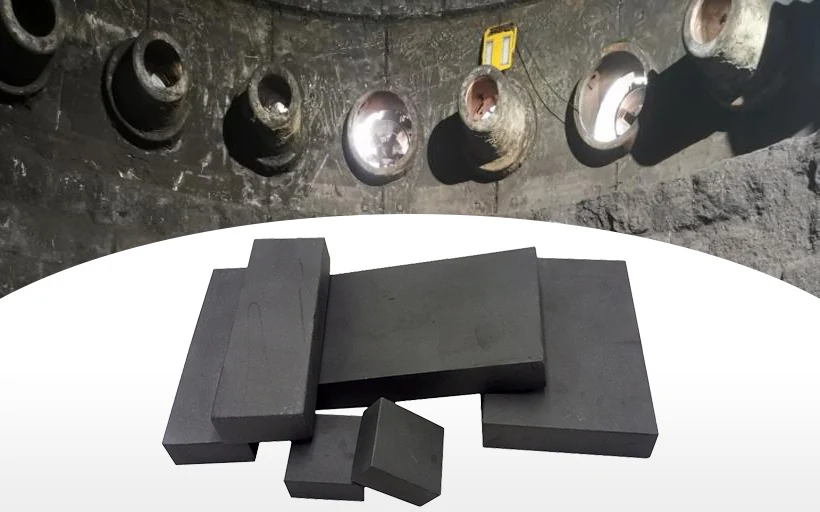
- Blast furnace — microporous carbon block, ceramic cup materials, Si₃N₄-bonded silicon carbide for the stack, and water-free injection mix for void filling behind the lining.
- Primary steelmaking — zonal magnesia-carbon packages for BOF and EAF, from charge pad through slag line to safety lining, with magnesia dry ramming and gunning mixes for hearth and repair duty.
- Secondary metallurgy and casting — AMC and carbon-free corundum-spinel ladle linings, plus the full flow-control range: slide gate plates, monobloc stopper rods, ladle shrouds and anti-clogging submerged entry nozzles.
- Hot blast stoves — the low-creep andalusite, high-alumina and fireclay checker grading system, which attracted sustained interest from plants planning stove relines.
What Visitors Wanted to Talk About
Three themes dominated the technical conversations. The first was zonal lining design — specifically how to stop relining a vessel on its weakest zone. Visitors described the familiar pattern: a converter or ladle that comes down because one zone is finished while the rest of the lining still has useful thickness. The zonal approach — assign a grade to each wear position and balance residual thickness at campaign end — resonated because it names the problem precisely and offers a design response rather than a product substitution.
The second theme was consumable reliability in flow control, particularly alumina clogging in submerged entry nozzles on aluminium-killed grades. The productive conversations here were diagnostic: whether the plant's problem was bore deposition, slag-band erosion or thermal shock at start of cast, because each has a different answer — carbon-free liners, zirconia bands or preheat-free designs respectively.
The third theme was verification. Buyers from the region increasingly want pore size distribution data for carbon products, nitrogen content for nitride-bonded SiC, and creep figures at stated test conditions for stove grades — not just alumina percentages on a catalogue page. That shift suits us: we publish the figures we test consistently and leave a cell blank when we do not, and explaining that policy at the stand produced some of the most substantive discussions of the week.
The Regional Market in One Sentence
If the exhibition floor had a single message, it was that buyers in Russia, the CIS and Central Asia are moving from buying bricks to buying documented performance — batch certificates, third-party inspection options, and suppliers who will stand behind a declared figure. Logistics was the natural second concern: sea and land freight routes, packaging that survives long transits, and delivery schedules aligned to maintenance windows rather than production convenience.
How Our Proposals Differ From Catalogue Quotes
Several visitors compared the proposals they received from us with the quotations they were used to, and the difference is structural rather than cosmetic. A catalogue quote lists products and prices; a zonal proposal starts from the vessel and its operating practice, and only then lists products — each justified by the wear mechanism of the position it serves. The document contains the grade map, the per-zone consumption forecast, the projected campaign life, and the controlling failure mode named for each zone. When the customer's engineering team reads it, they can check the reasoning line by line: if they disagree with the slag-line carbon level or the checker grading, the disagreement has an address.
This format also changes the commercial conversation. Comparing proposals becomes a technical exercise — whose diagnosis of the trunnion zone is right, whose consumption forecast matches last campaign's actuals — rather than a discount negotiation on a parts list. Not every visitor wants that level of engagement, and that is fine; the catalogue is still there. But the plants that are spending the most on refractory maintenance are, consistently, the ones most interested in reasoning they can verify.
What We Took Back to the Factory
Exhibitions are also reconnaissance, and three takeaways are already feeding back into production and documentation. First, the demand for verification data is growing faster than any standard questionnaire, so we are expanding the default documentation package — pore size distribution curves for carbon grades and creep certificates at stated test conditions will ship with the standard COA rather than on request. Second, the zonal proposals land better when the consumption forecast is expressed per ton of steel rather than per campaign, because that is how plant controllers actually budget; the proposal template has been rewritten accordingly. Third, Russian-language technical documentation was requested repeatedly, and the translation programme for the core product documentation is now scheduled. None of these changes is dramatic. All of them came from thirty-second conversations at the stand that would have taken months of email to surface.
Follow-Up
Technical discussions from the exhibition are continuing, with several plants sending furnace drawings and operating data for zonal lining proposals. The proposals follow the same format for every region: a grade per wear zone, a consumption forecast, and the controlling failure mode stated for each position — so the customer's engineering team can check the reasoning, not just the price.
If we met you at the show and you have not yet received your proposal, contact the export team and we will prioritise it. And if you did not attend but are planning linings for the same equipment — blast furnace, converter, ladle or stove — the technical entry points are the same: our blast furnace and BOF converter system pages collect the product ranges by application.