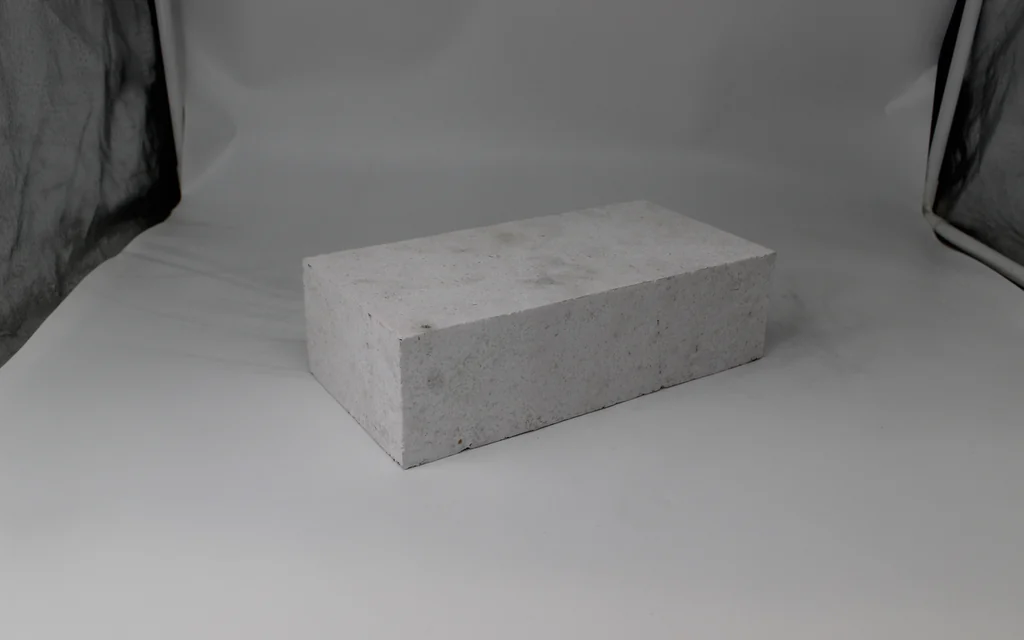
Beneath every long blast furnace campaign is a hearth bottom whose design philosophy can be stated in one sentence: protect the carbon structure, because the carbon is what lasts. The ceramic cup and microporous carbon block are the two components that carry that philosophy — one as a sacrificial shield, the other as the permanent structure — and their interaction is where hearth design either works or quietly does not. These are the design notes we apply to every hearth package.
The Carbon Structure: Why Microporous Matters
The carbon block is the hearth's structural element: it sets the campaign because it is the material the furnace cannot practically replace. Its enemy is molten iron penetration, and penetration is governed not by total porosity but by pore throat diameter — iron enters through the largest connected channels and stops where channels narrow below its penetration threshold. Conventional carbon block, with pore throats in the several-micron range, allows a penetration zone to develop at the hot face; microporous block, engineered so the dominant pore throats sit below one micron, holds the penetration depth shallow enough for the thermal model to account for. That is the entire argument for microporous carbon: a hearth whose wear depth is predictable is a hearth whose 15-year design is credible. Add the high thermal conductivity — pulling the 1150 °C isotherm inward, away from the shell — and the microporous layer is doing penetration resistance and thermal management at once.
The Ceramic Cup: A Shield With a Job Description
The ceramic cup — corundum or chrome-corundum materials inside the carbon — exists to take the first months of erosion so the carbon never sees unshielded iron contact. Early campaign operation is the dangerous period: the freezing layer that ultimately protects the hearth has not stabilised, and fresh iron at full superheat works the hot face directly. The cup absorbs that period, then stabilises behind a frozen iron/slag layer and does little for the rest of the campaign — which is its correct job description. The design detail that decides whether the cup performs is the joint to the carbon: oxide and carbon materials expand differently, and the joint must absorb that differential through its geometry and the ramming mass behind it, or the cup cracks where the stress concentrates and its protection fails at exactly those locations.
The Heat Path: A Series Circuit Review
Hearth design is thermal management before it is materials selection. Heat arrives at the hot face and must leave through the cooling system, and every layer in between — cup, ramming mass, carbon block, ramming behind the block, cooler — is a resistance in series. The weakest resistance dominates: a five-millimetre void behind the block insulates more effectively than any material choice can compensate. Hence the package discipline — matched ramming masses specified to fill without shrinkage, water-free injection to restore contact behind the lining when service voids develop, and cooling water flow verified against the design heat load. Materials choices and assembly quality are not alternatives; the assembly quality is what the materials choices assume.
Monitoring the Design in Service
A hearth design carries its own verification plan: thermocouple locations chosen so the isotherm position can be inferred, trend thresholds set from the thermal model, and rate-of-rise watched alongside absolute level. The design is validated not at commissioning but over years of stable readings — and when a trend does move, the response ladder is graduated: verify cooling performance first, water-free injection second, operating adjustments third. The plants that run this discipline convert hearth management from anxiety into maintenance.
The 1150 °C Isotherm, Used as a Management Tool
The 1150 °C isotherm — the locus within the hearth where the lining reaches the temperature at which molten iron begins to solidify against refractory — is the single most useful number in hearth management, and it is worth stating what it does and does not tell you. Its position marks the practical wear limit: inside it, iron is liquid and attacking; outside it, iron freezes and protects. Design intent is to keep that isotherm inside the ceramic cup and well away from the carbon block's hot face for the whole campaign, which is exactly what the microporous structure and the cooling system are jointly engineered to achieve. Its rate of movement is the operational signal. A isotherm that sits stable for months says the freezing layer has stabilised and the design is working. A isotherm that migrates outward over weeks says one of three things, in order of likelihood: cooling performance has degraded, a void has opened behind the lining, or hot metal chemistry and throughput have moved outside the design envelope. Reading it requires the thermocouple array to have been placed with the model — a hearth instrumented without reference to its thermal model produces numbers, not insight — and requires absolute levels to be read alongside the trend, since a slow steady drift and a step change have different root causes and different responses.
Commissioning: The First Ninety Days Decide the Campaign
New hearths fail early or they run for fifteen years, and the difference is usually made in the first months. Commissioning discipline has four parts. Dry-out and heat-up follow the material suppliers' curves rather than production urgency: carbon ramming masses and castables contain moisture and binders that must leave through the lining, and a rushed heat-up drives them out as steam pressure, opening paths that will later be penetration paths. Cooling verification happens before the first tap and again after, with flow and temperature rise per circuit recorded as the baseline against which every future reading is judged. Early filling practice is conservative — lower throughput, controlled superheat, no sharp excursions — while the freezing layer establishes. Baseline thermocouple capture at full production then fixes the reference trend. Plants that compress this schedule to recover a few days of production regularly spend weeks of campaign life paying for it, because the damage done during heat-up is inside the lining where no inspection will find it until it is a temperature trend with no good answer.
The Package, Summarised
Our hearth packages ship as one engineered set: microporous carbon block for sidewall and bottom, ceramic cup materials with joint geometry detailed, matched high-conductivity ramming mass, water-free injection compound for service, and the thermal model that ties them together with the monitoring plan attached. The components are documented on the microporous carbon brick, ceramic cup, high-conductivity carbon ramming mass and water-free injection mix pages, with the full furnace structure on the blast furnace system page and a large-scale application in the MMK Magnitogorsk case study. If you are designing a hearth or investigating a temperature trend, send the drawing and the data — the thermal path review is free and comes back within 48 hours.