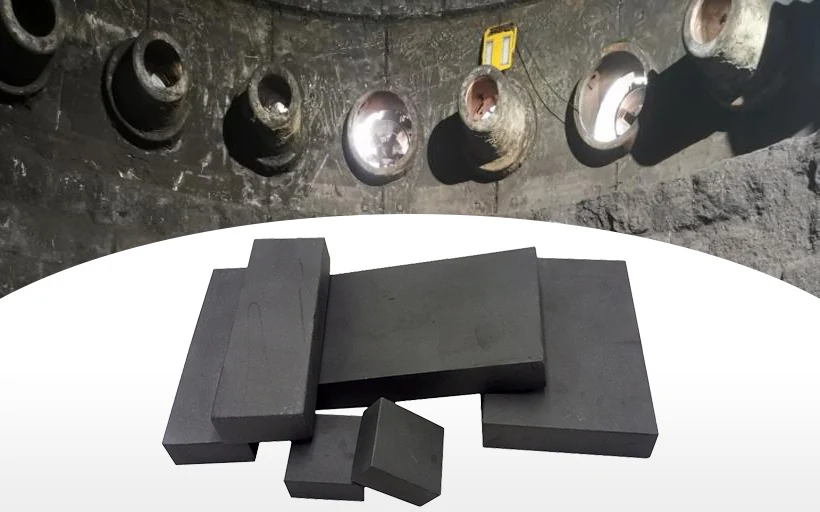
Waterless taphole clay has become the default on most medium and large blast furnaces, and for good reason. But water-bonded clay has not disappeared, and the decision is more nuanced than "newer is better". This article sets out what removing water actually changes, where water-bonded clay still fits, and the operational variable — plasticity — that decides the outcome either way.
What Removing Water Changes
When water-bonded clay meets the furnace environment at the taphole, the water flashes to steam. That single fact produces three consequences, and each one is a performance problem in disguise:
- Erratic opening behaviour. The steam pressure spike disrupts the clay column at the moment of opening, so plug behaviour varies shift to shift. Waterless clay removes the spike, and with it most of the variance — opening becomes a function of the drill and the clay, not the weather inside the taphole.
- Shorter, less stable taphole length. Steam ejection and the associated spalling erode the channel mouth, so the taphole length the furnace team tries to maintain gets consumed faster. A waterless column holds geometry better through the tap, which slows recession at the taphole face and lengthens the interval between taphole rebuilds.
- Higher fume load. Steam flashing produces visible fume at the taphole — immediately noticeable to the casthouse crew and a real load on the fume capture system. Removing it improves the working environment and takes demand off the gas cleaning plant during casting.
The Campaign-Level Effect
Individually these are operating details. Together they compound into the campaign argument: a stable taphole length stabilises the drainage pattern at the end of the tap, which stabilises hearth drainage, which stabilises the hot metal chemistry at tap end — and taphole maintenance intervals stretch because the channel erodes predictably instead of randomly. Casthouse teams converting from water-bonded to waterless clay typically report the change first as variance reduction: fewer erratic openings, fewer extended casts, fewer surprises. The consumption figure per ton of iron then follows, because predictable tapholes are maintained on plan rather than on emergency.
Where Water-Bonded Still Fits
On smaller furnaces with less demanding throughput, the operational benefits may not justify the price difference — particularly where crews are experienced with existing practice, tapping is already consistent, and the clay supplier actually supports the gun with technical service. A well-maintained water-bonded practice on a modest furnace outperforms a badly implemented waterless conversion. The conversion also has a learning curve: gun settings, drill practice and storage all need adjustment, and the first month after a conversion is a commitment, not a trial.
Storage and Handling: The Part Everyone Skips
Clay's plasticity window is destroyed more often in storage than in formulation. Palletised clay left through a monsoon-season warehouse, or a winter shipment held in an unheated yard, arrives outside the band no matter how well it was made — and the casthouse crew experience this as a supplier quality problem that no inspection at despatch could have caught, because the material was fine when it left. The protections are simple and belong in the purchase order: store between the stated temperature band, keep the moisture-barrier packaging sealed until point of use, rotate stock by the date stamp, and never stage more than a shift's quantity at the gun. Suppliers share responsibility too: our batches are date-stamped, plasticity-verified against the declared window, and shipped with storage guidance in the same language the crew reads. A clay programme succeeds when both sides treat storage as part of the specification — and fails, expensively and mysteriously, when either side treats it as warehousing.
Converting: A Six-Week Plan That Works
For casthouse teams planning a conversion, the sequence that produces a clean decision is short. Weeks one to two: run the existing clay with instrumented taps — record opening time, taphole length at start and end, cast duration and drainage quality — so the baseline exists. Week three: receive the waterless clay, check plasticity on arrival against the gun specification, and adjust gun settings off-line, not in the furnace. Weeks four to five: run the conversion on a supported schedule with the supplier's engineer present for the first shifts, holding taphole length deliberately rather than chasing the old number. Week six: compare the two data sets and decide on evidence. Teams that skip the baseline almost always misread the transition week as failure, because variance during settings changes is real. Teams that follow the sequence end the six weeks with a decision their crew owns — which is what makes the new practice stick after the supplier's engineer goes home.
Reading a Taphole Data Sheet Properly
Taphole clay data sheets reward a different reading discipline than brick sheets, because the governing properties are rheological rather than purely chemical. Chemistry matters — the Al₂O₃/SiC/C balance sets the corrosion and erosion resistance of the channel — but the properties that decide daily performance are workability-related: extrusion behaviour at gun temperature, plasticity window width, and sintering speed at operating temperature. A sheet that publishes only chemistry is describing half the product. Ask for the plasticity window in temperature terms, the recommended storage band, and the sintering behaviour at the furnace's taphole face temperature; ask, too, whether the formulation can be tuned to the gun — a good supplier adjusts the plasticity target to your equipment, not the reverse. The waterless/water-bonded distinction itself should be stated prominently on the sheet, along with any fume-capture implications, because the casthouse crew are the product's daily users and their working environment is part of the specification whether or not the purchase order admits it.
The Variable That Actually Decides
Plasticity. Clay must be soft enough to extrude cleanly through the gun and stiff enough to hold the channel under ferrostatic pressure, and that window is temperature-sensitive. Storage outside the recommended band — a winter warehouse floor, a container in summer sun — is the most common reason a good product behaves badly. This is why we control plasticity to the customer's gun specification, ship with storage temperature guidance, and date-stamp every batch: a clay whose storage history is unknown is a clay whose behaviour will be blamed on the furnace.
If Opening Is Erratic
Before changing product, check three things: plasticity versus gun setting, storage temperature history, and the taphole length carried over from the previous tap. Most "clay problems" are one of those three. We will look at your tapping records before recommending a change, because sometimes the answer is not the clay — and when it is the clay, the waterless taphole clay page carries the formulation details, and the blast furnace system page shows where it sits in the casthouse package. The MMK Magnitogorsk project shows water-free technology applied at integrated-mill scale.