Blast furnace stack linings fail by alkali attack, zinc penetration, abrasion from the descending burden, and temperature excursions — a combination that eliminates most refractory chemistries on contact. Silicon carbide materials survive there because no single property dominates: they are hard, chemically stable, thermally conductive and thermally shock resistant at once. But "SiC brick" covers two bonding systems with different behaviours — nitride-bonded and self-bonded — and choosing between them is a stack-design decision worth making deliberately.
Why SiC Owns the Stack Duty
The stack's enemies arrive together. Alkali vapours (potassium and sodium circulators) condense in cooler zones and react with alumino-silicate bonds, swelling and disintegrating conventional brick. Zinc follows a similar cycle, depositing and expanding in the lining pores. The burden column abrades anything that protrudes, and descending charge grinds continuously. SiC bodies resist all four: high hardness resists abrasion; the carbide chemistry is largely indifferent to alkali attack at stack temperatures; low porosity and fine structure slow zinc penetration; and high thermal conductivity — several times that of high-alumina — keeps the hot face temperature down and flattens the gradients that drive spalling during excursions.
Nitride-Bonded SiC: The Premium Answer
In nitride-bonded brick, silicon carbide grains are bound by a silicon nitride (Si₃N₄) phase formed during firing in nitrogen atmosphere. The nitride bond is the reason for the grade's premium behaviour: it resists oxidation better than oxide bonds, it maintains strength at temperature, and it is chemically stable against the alkali and zinc cycles that destroy conventional bonds. The measurable evidence that the bond actually formed is the nitrogen content — which is why any Si₃N₄-bonded data sheet that omits nitrogen is asking to be doubted. Nitride-bonded grades are the specification of choice for the bosh, belly and lower stack, where temperature, alkali circulation and abrasion peak together and where a premature lining failure costs a furnace suspension.
Self-Bonded SiC: The Rational Alternative
Self-bonded (or oxide-bonded) SiC trades some of that chemical ceiling for cost, and in the right positions the trade is correct. In the upper stack and cooling-stave-protected zones, where temperatures are lower and the duty is primarily abrasion with moderate alkali, self-bonded grades deliver most of the service life at a meaningfully lower unit price. The specification discipline is the same: verified SiC content, controlled porosity, and — critically — dimensional tolerance, because stack brick sits in ring courses where accumulating tolerance error opens joints exactly where alkali condensation wants a path.
Oxidation: The Mechanism That Eventually Ends Every SiC Lining
Silicon carbide is thermodynamically unstable in any atmosphere containing free oxygen, and the stack contains it — in the charge itself, in leaks, and in the excursions that follow a furnace upset. The reaction is a two-branch problem. Passive oxidation forms a thin, adherent silica film on the grain surface that slows further attack and is, for practical purposes, the material protecting itself; this is the regime a correctly specified SiC brick should live in. Active oxidation — favoured above roughly 1600 °C and at low oxygen partial pressure — produces volatile silicon monoxide instead of a protective film, and material leaves the brick as gas. The transition between the two is what a stack lining is managed against: keep the hot face below the transition temperature and in an atmosphere where silica forms, and the lining ages slowly; let it cross, and thickness disappears without any visible spalling to explain it. Two specification consequences follow. First, thermal conductivity is an oxidation control as much as a thermal one — a brick that moves heat inward keeps its own hot face cooler, further from the active regime. Second, the bonding phase decides the timing: nitride bonds hold the grain network together longer under the same oxidation depth than oxide bonds, which is the microscopic reason nitride-bonded grades survive where self-bonded ones do not.
Installation Detail: Rings, Tolerances and Expansion Allowance
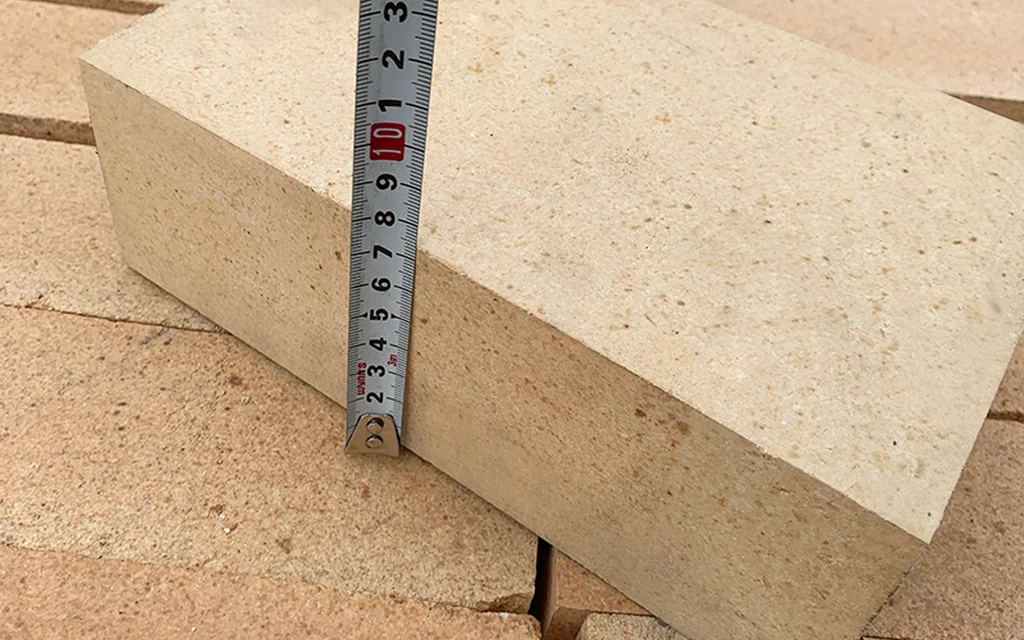
Stack brick is not laid; it is assembled by course, and the courses are what decide whether the chemistry gets its chance. Three installation errors recur across furnace sizes. The first is accumulating dimensional tolerance: individual bricks within specification still open a joint when their tolerances all fall the same way around a ring, and the alkali condensation zone is precisely where the open joint becomes the attack path. Requiring dimensional reports on ring-course shapes and sorting by measured size before laying is cheap insurance. The second is insufficient expansion allowance: SiC's expansion behaviour differs from the high-alumina and carbon materials above and below it, and a ring laid tight against a rigid boundary will either spall at the hot face or lift the course above it. Allowance is designed into the course drawing, not improvised on the scaffold. The third is joint material mismatch — a mortar chosen for availability rather than for SiC chemistry, leaving a lower-melting, higher-porosity seam through an otherwise alkali-resistant course. All three are workmanship items, which is why installation supervision on a first SiC stack reline is worth more than any further laboratory testing of the brick.
Where Each Belongs: A Practical Map
- Bosh and belly — nitride-bonded, without exception on furnaces of any size; the duty combines every mechanism at maximum intensity.
- Lower and middle stack — nitride-bonded on large furnaces and long-campaign designs; self-bonded defensible on smaller furnaces with stave cooling and moderate campaign targets.
- Upper stack — self-bonded SiC or high-quality high-alumina, chosen on abrasion duty and cost; the temperature here no longer justifies the nitride premium.
- Tuyere surroundings — nitride-bonded SiC or sialon-bonded variants, where excursions and coke motion punish everything softer.
Verification and the Numbers That Matter
For either bonding system, the specification conversation should name four numbers: SiC content, nitrogen content (for nitride-bonded), apparent porosity, and thermal conductivity at working temperature — the last because the conductivity advantage is doing quiet structural work keeping the hot face cooler. Batch Certificates of Analysis should accompany the consignment, and dimensional reports on the ring-course shapes are worth demanding: stack brick is installed by ring, and tolerance is a chemical protection's first line of defence.
The grades are detailed on the Si₃N₄-bonded SiC brick, SiC-mullite brick and sialon-bonded SiC brick pages, with the full stack-to-hearth structure on the blast furnace system page and the applied project in the MMK Magnitogorsk case study. Planning a stack reline? Send the furnace profile and campaign target — the course-by-course material map is free within 48 hours.