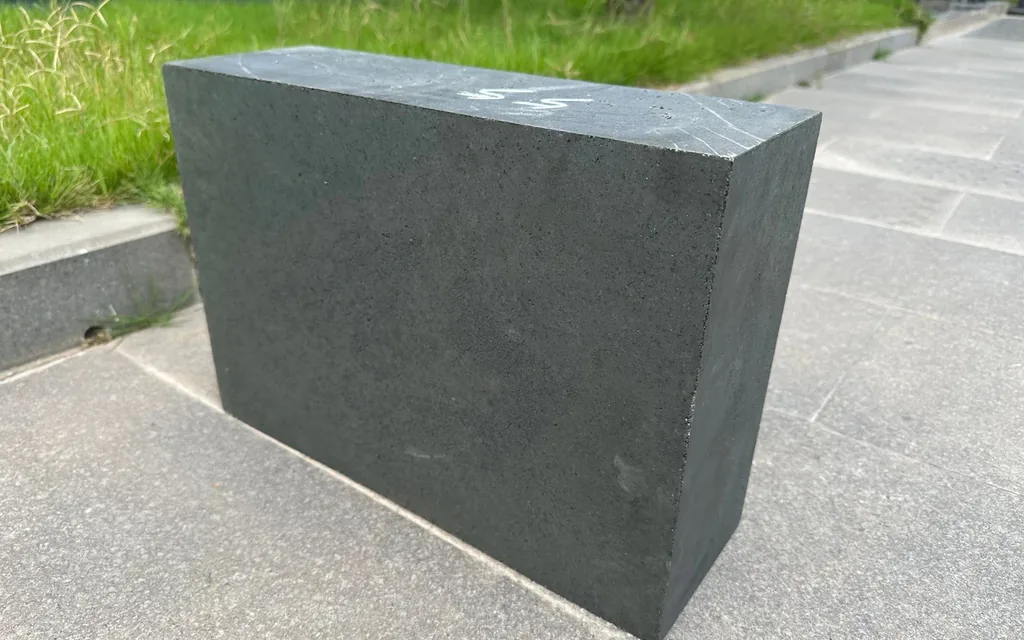
One of the most persistent misconceptions in refractory buying is that higher carbon content means a better magnesia-carbon brick. It does not. Carbon content is a position specification: the right value depends on which zone of the vessel the brick sits in and what mechanism is trying to destroy it there. Buying a single high-carbon grade for a whole vessel is not a premium choice — it is a misallocation, because it spends money in zones that do not need it and starves the zones that do.
What Carbon Actually Does
Carbon contributes three things to a magnesia-carbon brick, and charges three costs. It is not wetted by basic slag, so it blocks slag penetration into the brick. It raises thermal conductivity, which moves heat away from the hot face and reduces the temperature gradient that drives thermal spalling. And it gives the brick mechanical compliance, allowing the lining to absorb thermal cycling without cracking. The costs: more carbon lowers hot strength, increases oxidation risk, and adds to the carbon that can be picked up by the steel.
A zonal specification is simply the recognition that these benefits and costs are not uniform around the vessel. There is a second interaction worth naming: carbon content works together with magnesia purity. High-carbon grades earn their carbon only if the MgO behind it is pure enough to resist the slag once the graphite has done its job — which is why slag-line grades pair high carbon with 96–97% sintered or fused magnesia, while a mid-carbon barrel grade on a less aggressive route can run a more economical magnesia without measurable loss of life. Reading carbon and MgO purity together, rather than one at a time, is what separates a zonal specification from a parts list.
Mapping Carbon Level to BOF Zone
- Charge pad and cone — 14–17% C. Scrap charging impact dominates the wear. These grades are tuned for high cold crushing strength and toughness, with the antioxidant package protecting the carbon during the temperature excursions of charging.
- Slag line and metal zone — 14–19% C. Chemical dissolution by FeO-rich refining slag dominates. Carbon is raised, MgO purity pushed upward, and antioxidant additions — Al and Si at lower temperatures, SiC and B₄C through 1400–1600 °C — slow the oxidation that precedes slag attack.
- Trunnion and barrel — 12–14% C. Moderate slag contact combined with severe thermal cycling during every blow. This is where compliance matters most; over-specifying carbon here costs hot strength without buying life.
- Safety lining — around 4% C with 89% MgO. Carbon is deliberately minimised: the safety lining should be chemically stable, thermally insulating and indifferent to steel chemistry.
- Clean-steel ladle service — 10–11% C or carbon-free alternatives. Where carbon pickup into ultra-low-carbon steel is a reject risk, the working lining itself becomes part of the steel chemistry conversation.
The Antioxidant Package in Detail
Because oxidation precedes slag attack in most converters, the antioxidant system is where much of the engineering value in a magnesia-carbon brick lives. The chemistry works in staged sacrifice: metallic antioxidants such as aluminium and silicon react preferentially with oxygen first, forming ceramic phases that plug pores and slow further oxygen transport. As service temperature rises, the demand shifts to carbide-forming antioxidants — silicon carbide, and at the highest temperatures boron carbide — which continue capturing oxygen and reinforcing the brick's hot face. A single-antioxidant formulation cannot cover the whole temperature window; graded formulations match the package to the thermal reality of each zone.
This is also why a data sheet should state the antioxidant package, not just the carbon percentage. Two bricks at 14% C can differ substantially in oxidation resistance depending on whether the package is tuned for a 100 t ladle or a 300 t converter blowing at high oxygen potential.
Reading Grade Designations Without a Decoder Ring
Refractory grade codes look opaque but encode exactly the zonal logic described above. In the XZK naming convention, the number is carbon content (XZK-MC-14 = 14% C), and the suffix letters identify the antioxidant package and strength class — F2 denotes an Al/Si metallic package for general converter duty, AS and AF variants adjust the package for slag-line oxidation resistance or charge-pad toughness, and the digit that follows (F2/F3) marks the strength tier within the package. Once decoded, a lining drawing becomes legible: charge pad at 14AF1/F2, slag line at 14AF2/F3, barrel transition at MAC grades, safety lining at MC-4F3.
The value of a legible code is practical: installation crews can verify zone against pallet marking without engineering supervision, and the inevitable mid-campaign repair order quotes the same code the original drawing used.
Oxidation Is Usually the Real Limiter
In most converters, carbon oxidation precedes slag corrosion. Once oxygen or FeO reaches the graphite, the non-wetting barrier is gone and slag penetration accelerates. This is why antioxidant selection usually buys more campaign life than simply specifying more carbon: the antioxidant sacrifices itself to oxygen preferentially, forming protective phases that block further attack. Matching the antioxidant package to the service temperature window is more valuable than adding carbon points.
A Practical Test of Supplier Discipline
Ask any supplier to justify the carbon content of each grade against a zone, not a catalogue. If the answer is a single grade for the whole vessel, the lining will be relined on its weakest zone — because with one grade everywhere, the harshest zone always fails first and the rest of the lining is discarded with it.
Our magnesia carbon brick page shows the full zonal grade matrix from 4% to 19% C, and the dedicated BOF magnesia carbon brick page details the converter-specific grades. To see the zonal approach applied on a 300 t converter, read the Hyundai Steel Dangjin case study, or review the complete BOF converter refractory system.
Send us your vessel capacity, blowing practice, slag basicity and FeO, scrap practice, and current campaign life with the controlling zone. We will return a zone-by-zone grade map with a consumption forecast — free, within 48 hours.