Refractory materials science sits in an awkward gap between disciplines: too industrial for most university ceramics departments, too specialised for generic materials programmes. XZK's answer to that gap is the model common to Henan's refractory cluster — sustained partnerships with Chinese ceramic research institutes and university materials departments, structured so that academic depth and production reality feed each other instead of corresponding by email.
How the Partnership Is Structured
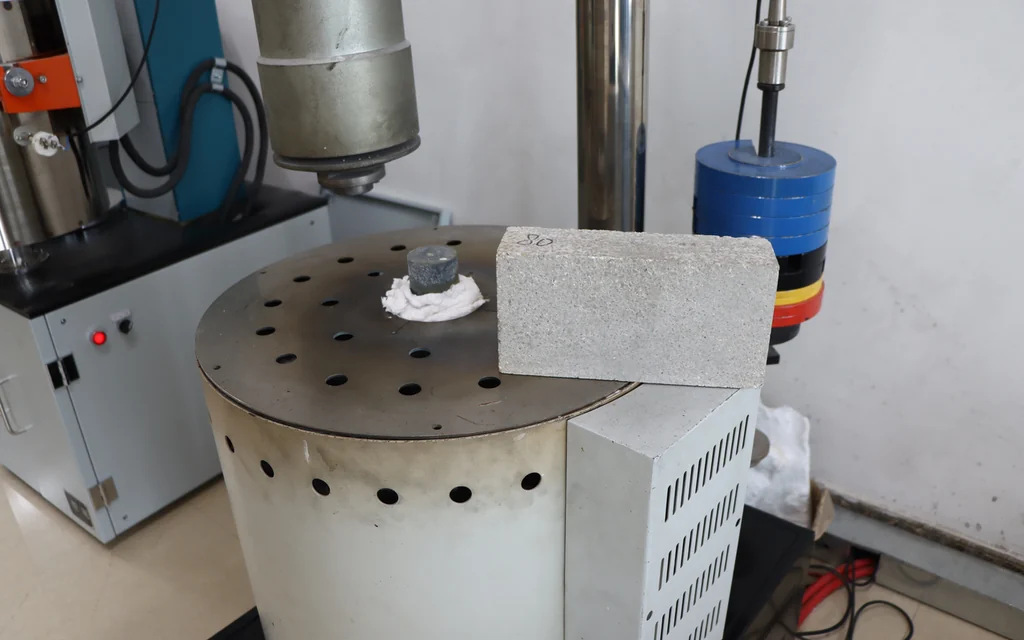
The collaboration runs on three tracks. The first is joint research programmes: defined topics — spinel formation kinetics, creep mechanisms in andalusite-based bodies, pore structure control in carbon materials — pursued with institute laboratory capacity alongside XZK's own testing centre, with results published or patented according to the topic's commercial sensitivity. The second is shared instrumentation: tests that do not justify in-house duplication — advanced microstructural characterisation, specialised high-temperature microscopy — are accessed through partner laboratories, while routine batch testing stays in-house where the volume belongs. The third is the people pipeline: graduate engineers from partner programmes join the R&D centre already familiar with refractory microstructure, shortening the years-long apprenticeship the industry otherwise requires.
What the Partnership Produces
The output that reaches customers is specification substance, and it accumulates rather than arrives. A recent thread illustrates the pattern: the spinel formation work clarified how the timing of the MgAl₂O₄ reaction during firing controls the micro-expansion curve in AMC brick and carbon-free castables — which is why XZK's grades seal joints predictably instead of approximately, and why the expansion figure on the data sheet has a mechanism behind it rather than a footnote. Similarly, the creep programme underpins the low-creep andalusite grading used on hot blast stove domes: the firing curve that produces the interlocked mullite microstructure came out of that research, and the creep certificate per batch exists because the mechanism is understood well enough to know what must be controlled in production. Each finished thread becomes part of the recommendation engine behind the product range — so when a customer asks why a grade is specified the way it is, the answer has a laboratory trail, a production validation, and usually a patent number where the mechanism was novel enough to protect.
Why It Matters Commercially
For buyers, the partnership model answers a question that catalogue comparisons cannot: where does a recommendation come from? When an XZK engineer proposes a specific antioxidant package for a converter slag line, or a specific firing curve check for a stove reline, the recommendation traces back through measured service behaviour to laboratory work that was designed to answer exactly that question. Suppliers without research depth answer the same question with precedent — "this is what we ship" — which is fine until your furnace differs from their precedent. The plants that bring us their hardest problems, the ones that have already tried the standard answers, are the ones for whom the research trail is not academic decoration but the reason to engage.
A Semester in the Laboratory: What Collaboration Actually Looks Like
Because partnership announcements are easy and working relationships are hard, it is worth describing the texture of a typical joint programme. A topic begins as a production question — usually a service behaviour we can measure but not yet explain. The institute side designs the fundamental experiments: controlled compositions varying one variable at a time, characterisation at microstructural scale, the discipline of isolating mechanisms that production data entangles. XZK's side brings the production reality: industrial-scale compositions, firing curves that a real kiln can run, and the service tests that connect laboratory findings to furnace behaviour. The two sides meet at defined milestones, and the honest ones are more valuable than the pleasant ones — a laboratory result that does not survive contact with a production firing curve is exactly what the collaboration exists to discover cheaply. The semester ends with either a mechanism we can engineer against, or a documented dead end that saves the next programme from repeating it. Both outcomes end up in products eventually: the first as a grade with a defensible specification, the second as the institutional knowledge behind a data sheet that states its numbers carefully.
What Students and Junior Engineers Gain From the Industry Side
The pipeline runs in both directions, and the industry side of the exchange is worth describing because it explains the engineers the programme produces. A graduate arriving at the refractory industry from a materials programme knows phases and microstructures; what the production floor adds is the sense of scale and consequence that no laboratory teaches — that a firing curve is not a graph but a kiln campaign with fuel and schedule, that a batch record is a promise a customer will verify, and that a lining failure is not data but a plant's production plan burning. Joint-programme students spend time in the workshops and, where possible, at installation sites, so the mechanisms they study arrive attached to the equipment they govern. The engineers who come through this route ask better questions faster — not because they know more materials science, but because they know what the science is for. That is the actual product of the people pipeline: not headcount, but judgement, which the refractory industry has always been short of and always will be.
Standards Work as Peer Review
The partnership structure also connects to standards participation. Contributing to documents like GB/T 4984-2023, GB/T 44333-2024, JC/T 2574-2020 and T/CSTM 00853-2024 subjects a manufacturer's testing practice to examination by peers and competitors — writing a test method that the industry will judge you by is the strongest incentive to keep laboratory discipline honest. That outside scrutiny, combined with institute collaboration, is how XZK's data has stayed defensible as the product range has widened.
For Researchers and Engineers
XZK's research centre welcomes collaboration enquiries from materials departments and institutes working on high-temperature ceramics — joint programmes, shared characterisation capacity, and industrial test beds for laboratory concepts that need a furnace to prove themselves. Contact the export team with a short description of the topic and it will be routed to the research centre. For the products the research feeds, start from the magnesia alumina spinel brick, low-creep andalusite brick or microporous carbon brick pages — each states which property governs and which research thread explains it.