Mexico · Monclova
Altos Hornos de México (AHMSA) — 150 t Torpedo Car Full Refractory Package
150 t torpedo car — complete refractory supply
Read Case Study →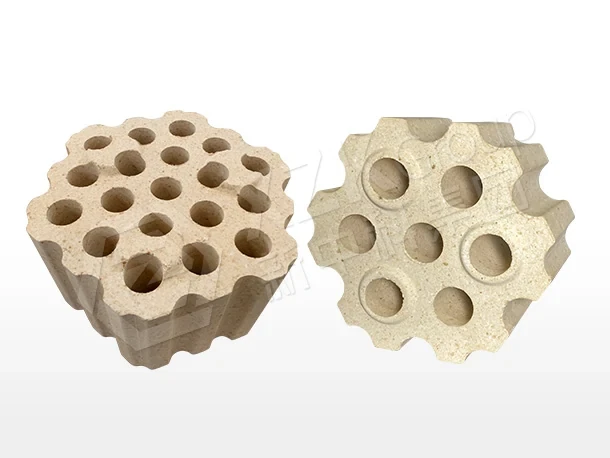
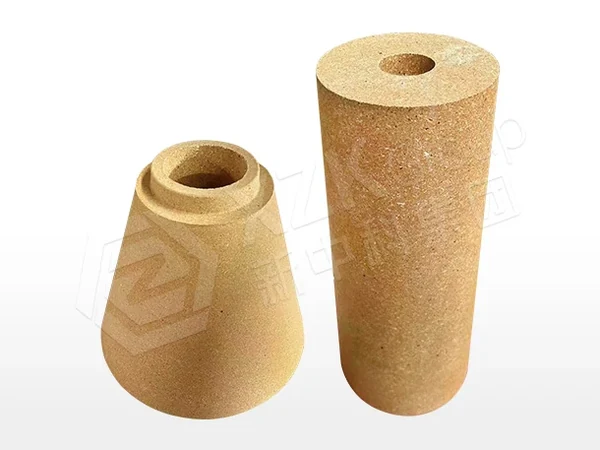
XZK delivered a course-graded refractory package for the No.3 blast furnace hot blast stove at Baosteel Zhanjiang, from low-creep dome grades to fireclay checkers.
Hot blast stoves are relined rarely, expensively and — if the specification is wrong — for the wrong reason. A stove rarely comes out of service because its brick dissolved. It comes out because the checkerwork changed shape: the channels closed, pressure drop rose, and the stove could no longer deliver blast at design temperature within the available cycle time. For the No.3 stove at Baosteel Zhanjiang, XZK supplied a course-graded package built around creep resistance rather than alumina content.
Zhanjiang is a modern, large-scale integrated works where blast furnace availability is the upstream constraint on the whole mill. Its hot blast stoves are sized for high blast temperature and long campaign, and the stove reline is a planned capital event rather than a maintenance window. That changes the specification logic: with a long design campaign and an expensive outage, the cost of getting the grading wrong dwarfs the cost of any individual brick.
The plant's specification question was not "which is the best brick" but "where does each grade stop paying for itself". Temperature falls continuously with depth through a stove, and the failure mechanism changes with it: sustained load plus peak temperature at the dome and upper checker, load with moderate temperature in the mid courses, and primarily mechanical stability at the base. Running one premium grade from dome to bottom spends the premium where the duty no longer justifies it. Conversely, running a uniform mid-grade specification under-engineers the dome, which is the one position where failure is unrecoverable without a full stove outage.
The package was graded course by course, with the governing property for each course stated at the test condition that course will actually see:
Creep was the governing property in the specification, and it was verified per production batch rather than only at type approval. A creep figure is meaningless without its temperature, load and duration stated beside it, and every certificate in this package states all three.
Checker brick was pressed to tight dimensional tolerance on CNC hydraulic presses, because checkerwork performance is a system of material and geometry: the channels are only as open as the laying tolerance allows, and a brick pressed 2 mm oversize accumulates that error over dozens of courses, misaligning channels and letting hot gas short-circuit through the widest passages. Material was delivered course-sorted and labelled so the installation followed the design sequence, eliminating the risk of a course being laid with the wrong grade — an error that is invisible at installation and irreversible in service.
Installation followed the course schedule with joint thickness and alignment checked as workmanship items. Dry-out and heat-up followed the material curves, with the dome expansion allowance at the springing point verified before the stove went into cycling service — the detail that separates a combustion chamber that runs a full campaign from one needing a mid-campaign repair.
The graded package met the design campaign life while reducing material cost by roughly 15–25% against a uniform premium specification. Stove geometry held to design: no measurable channel closure, no drift in pressure drop across the campaign to date, and blast temperature delivered to specification. The cost saved was not lost performance — it was premium material that was never going to be exercised at the duty where it was removed.
Grading is not downgrading. Every course is specified to the temperature and load it will actually see, and the governing property at each course is verified per batch. Any stove specification still written as a single grade throughout is either overspending at the base or under-engineering the dome.
The grades are documented on the low-creep andalusite brick, low-creep high-alumina brick and checker brick pages, with the full system view on the hot blast stove page and a comparable large-furnace application in the Tata Steel Kalinganagar stove project.
150 t torpedo car — complete refractory supply
Read Case Study →
80–120 t EAF ladles — working lining, purging plug & well block
Read Case Study →
EAF slag line & ladle slide gate system
Read Case Study →Every batch of raw materials is chemically assayed. Finished refractory shapes undergo density, ultrasonic non-destructive testing, and pre-assembly gap verification prior to global packaging.