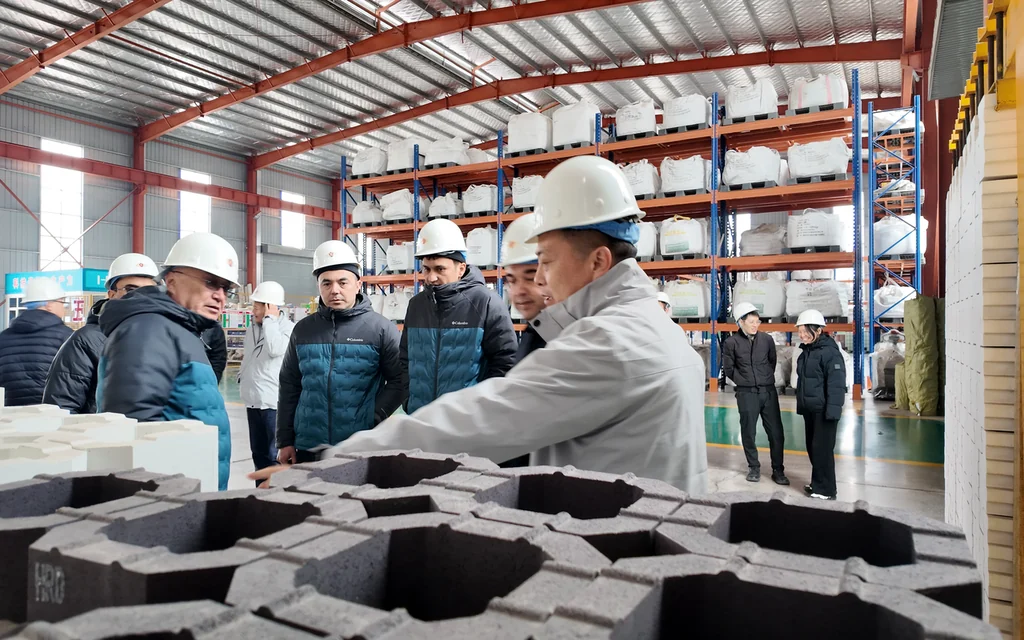
XZK has delivered an insulation and lining package for a 2500 m³ blast furnace hot blast stove in Türkiye, completing a supply that covers the working lining from dome to checker base together with a density-graded backup insulation system.
Package Contents
- Dome and upper checker — low-creep andalusite XZK-DR80, creep ≤0.2% at 1400 °C × 50 h, RUL ≥1580 °C.
- Mid courses — low-creep high-alumina XZK-RL65 and RL55, RUL 1470–1500 °C.
- Lower courses — low-creep fireclay checkers XZK-RN42 / RN40, RUL 1300–1410 °C.
- Insulation — a density ladder from mullite insulating brick at the hot face through lightweight high-alumina to lightweight silica in the sustained high-temperature zones, where volume stability matters most.
Insulation Designed, Not Bought
The insulation was specified as a system rather than a product, and the reasoning is worth recording because it is the part of stove specifications most often done badly. Backup insulation has two jobs that pull in opposite directions: it must insulate, which favours low density and high porosity, and it must carry load and resist shrinkage at temperature, which favours density and strength. A single-density backup is always wrong somewhere — either over-strong and under-insulating near the shell, or weak and shrinking at the hot face.
The density ladder resolves the conflict by position: densest and strongest nearest the working lining, where it backs up the brick and sees the highest temperature; stepping down toward the shell where the duty is purely insulating; and lightweight silica in the zones that sit above 1,100 °C continuously, because silica's volume stability at sustained high temperature is superior to alumina insulation at the same density. Each layer's classification temperature was checked against the calculated hot-face temperature of the layer in front of it, with a margin for the excursions that every stove sees during changeover cycles.
What the Customer Gets From the Ladder
A correctly graded insulation system lowers shell temperature, which protects the shell steel and reduces heat loss to the stove's surroundings — fuel that is bought every campaign and never recovered. It also protects the working lining from the other side: backup layers that stay volume-stable keep the support structure behind the brickwork true, so the working lining carries load as designed rather than bridging over a shrunk or compacted backup. On a 2500 m³ stove the material volume is large enough that these percentages are real money, both in capital cost and in every year of fuel consumption. The final check in the specification was thermal: the calculated shell temperature under design heat load was verified against the plant's limit, using the measured conductivity of each insulation layer rather than catalogue assumptions — because a ladder is only as good as its weakest layer's actual performance.
Course-Sorted Delivery: What It Looks Like on Site
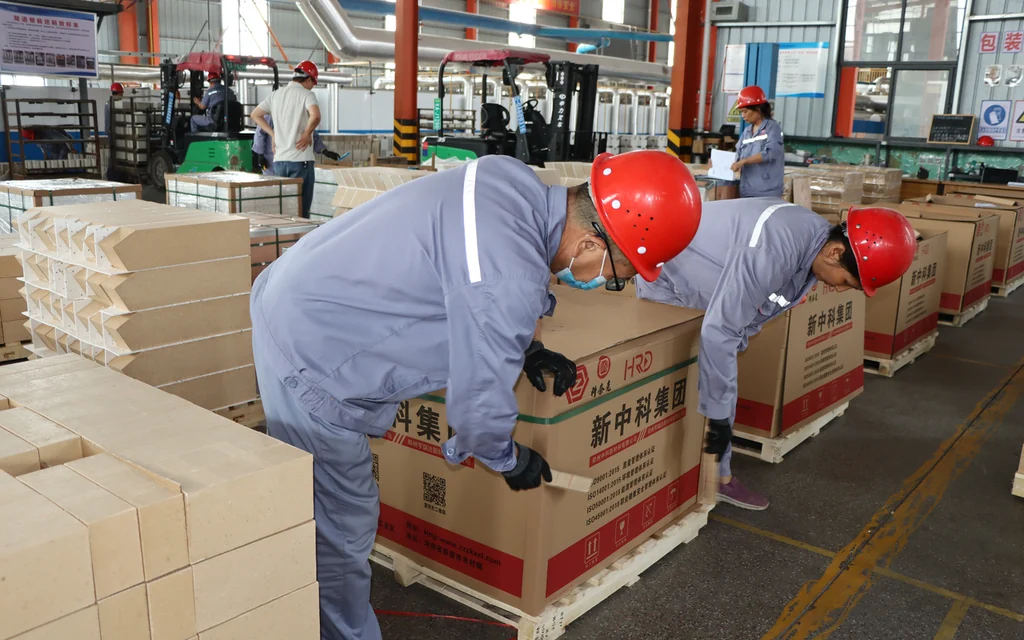
The phrase "course-sorted and labelled" appears in every stove delivery we make, and it is worth spelling out because it is invisible until its absence is expensive. Each pallet carries the stove identification, the course number, the grade code and the quantity; pallets are staged in delivery sequence so the crane or forklift at the site presents the next course, not a mixed pile that the installation crew must re-sort at height. The installation foreman signs against a packing list keyed to the design drawing, so a mislabelled or missing course surfaces at the site gate — where it costs a phone call — instead of three years later as a localised deformation in a checker column that no one can inspect. On this delivery the labelling was verified twice: once at packing in Xinmi, and once at the Turkish port during pre-shipment inspection. The second check cost us a morning; the first check failing would have cost the customer a campaign.
Commissioning Support for the Whole Package
Material supply on a stove project is half the deliverable; the other half is making sure the installation and first heat-up protect it. The package therefore included the installation procedures for each course group, the dimensional verification checklist keyed to the design drawing, and the heat-up curve for first firing — the ramp that cures the refractory without building steam pressure inside dense brickwork or shocking the insulation ladder before it reaches equilibrium. Heat-up is where good stove materials are most often wasted: an aggressive first firing can crack the dome courses or spall the hot-face insulation in a week, and the damage only shows up years later as uneven temperature distribution. Our engineers reviewed the customer's heat-up plan against the material set before despatch, which is standard practice on every stove package we ship, whether the furnace is 1,000 m³ or 5,800 m³. The review is not a formality — on this project it produced one change to the holding plateau length, which the customer's own refractory engineer then defended in front of his management as a requirement rather than a supplier preference. That is exactly the outcome a good heat-up review should produce.
Delivery and Installation Discipline
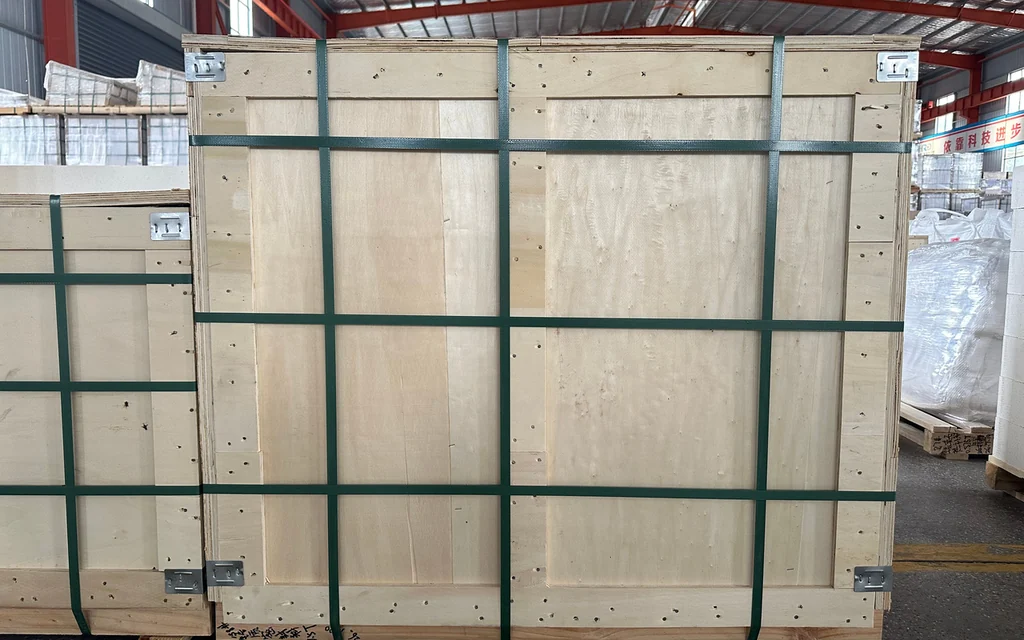
Checker brick was pressed to tight dimensional tolerance on CNC hydraulic presses, fired on controlled curves, and delivered course-sorted and labelled by course number and grade — the detail that sounds minor until an unlabelled course is laid with the wrong grade and discovered three years later as a localised deformation. Low-density insulation below 0.8 g/cm³ was crated rather than palletised, because edge crushing in transit is the usual failure mode for fragile insulation and a crushed insulating brick is a thermal short-circuit in the making.
Every batch shipped with its Certificate of Analysis covering chemistry, density and cold crushing strength, and the insulation layers carried their classification temperatures on the packing list so the installation sequence could be verified at the site gate rather than in a document review weeks later.
The grading philosophy behind this delivery is the same documented in our low-creep andalusite brick, mullite insulating brick and lightweight silica insulating brick pages, with the system view in the hot blast stove system overview. Planning a stove reline? Send the geometry and blast parameters and we will return a course-by-course grading proposal with the insulation ladder included — free, within 48 hours.