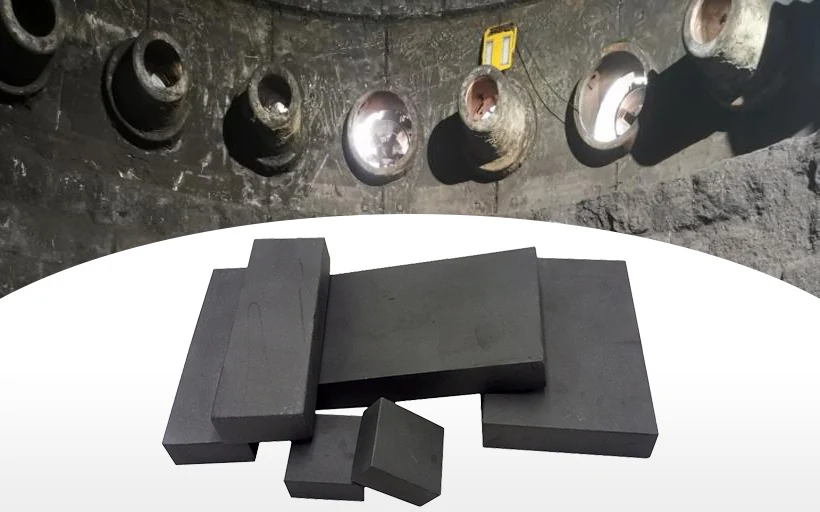
Submerged entry nozzle specification is an exercise in managing a direct trade-off. More carbon and a denser body resist erosion, but carbon is also what drives alumina deposition inside the bore. Less carbon keeps the bore cleaner, but the nozzle wears faster and the slag band eats through sooner. There is no single best answer — which is why XZK supplies seven SEN configurations, and why the specification conversation should start from the steel grade mix rather than from a catalogue.
Why Nozzles Fail: Four Mechanisms
- Alumina deposition in the bore — the dominant failure on aluminium-killed and low-carbon grades. Alumina inclusions adhere to the bore wall, the flow area narrows, metering accuracy is lost, and the sequence ends early. Carbon in the nozzle material promotes the adhesion, which is why more carbon makes this worse.
- Slag-band erosion — the slag line inside the mould attacks the nozzle body chemically. If the nozzle fails at a visible band while the bore stays clean, this is your mechanism.
- Thermal shock at start of cast — an unpreheated or inconsistently preheated nozzle meeting liquid steel at 1,580 °C can crack on first contact, ending the nozzle within minutes rather than sequences.
- Erosion at the ports and bore — high-velocity steel through the port geometry gradually enlarges the metering surfaces, changing the mould flow pattern even when the nozzle is otherwise intact.
The Four Anti-Clogging Routes
- Carbon-free liner — the usual answer for aluminium-killed and low-carbon grades. Removing the carbon driving deposition attacks the cause; typical liner chemistry is around 65% Al₂O₃ with 18% MgO and C+SiC held to ≤8%.
- Argon blowing — keeps the bore clear mechanically rather than chemically, by bubbling argon through channels in the nozzle wall. Effective where deposition is moderate and you want to keep standard liner chemistry; requires the plant's argon infrastructure to be reliable.
- Zirconia liner or band — resists slag-band attack where that, not the bore, is what ends the nozzle. Zirconia pays for itself on long sequences where the slag line would otherwise thin the body to failure.
- Preheat-free design — removes the preheat step and the thermal shock event at start of cast. This saves turnaround time and eliminates preheating inconsistency rather than extending life in-sequence; on caster-constrained plants the throughput benefit is often worth more than the consumable saving.
Diagnose Before You Change
These are answers to four different problems, and applying the wrong one wastes a trial. If flow rate falls progressively through a sequence, the problem is deposition — use a carbon-free liner or argon blowing. If the nozzle fails at a defined band above the ports, use zirconia. If nozzles are lost in the first minutes of casting, the issue is thermal shock, and preheat-free plus correct preheating practice is the fix. Photograph the sectioned failed nozzle before ordering replacements: the failure location tells the story, and any supplier who does not ask for it is guessing.
A Note on Geometry
Port angle, bore diameter and submergence depth set the mould flow pattern, which governs surface quality, slag entrainment and inclusion behaviour in the strand. A nozzle that is dimensionally correct but geometrically wrong for your mould section will produce defects even though nothing has "failed". This is why we ask for the mould model or the existing nozzle drawing with every enquiry — the geometry is part of the specification, not an afterthought.
The Seven Configurations, Briefly
Because "seven SEN configurations" invites the question of what they actually are, the practical map is as follows. The standard alumina-carbon body with zirconia slag band is the general-purpose baseline for mixed grade shops. The carbon-free liner configuration serves aluminium-killed and low-carbon grades where bore deposition dominates. An argon-blowing variant adds an inert gas flush through the wall for shops that prefer mechanical deposition control. A preheat-free body removes the start-of-cast thermal shock event for casters running tight turnaround. A zirconia-intensive configuration extends slag-band life for long sequences. A carbon-free body with internal argon covers the combination case, and an anti-oxidation-coated variant improves storage and preheat tolerance where shop practice is uneven. Each configuration exists because a specific failure pattern on a specific steel grade mix demanded it — none of them is a marketing variant, and none of them is right for every shop.
Working With the Caster Team, Not Just Procurement
One structural observation from hundreds of SEN programmes: the specification conversations that succeed involve the casting operator, not only the buyer. The operators know which strand position clogs first, what the flow meter says in hour six of a sequence, and whether the last trial failed at start of cast or at the slag band. That information is worth more than any data sheet, and it is why our specification template asks for the operating picture alongside the grade mix. Procurement-led SEN purchases that ignore the operating team routinely re-buy the same failure with a different brand name on the box. The reverse — a trial designed with the operators, one variable at a time, on one strand — produces a decision the whole plant stands behind, and it is how we prefer to work even when it makes the first sale slower.
Making the Trial Decisive
A good SEN trial changes one variable at a time, on one strand, for a defined sequence count, with bore flow data captured. Change liner chemistry and preheat practice in the same week and no one can attribute the result. We support trials with the failure analysis beforehand and the sectioned-nozzle report afterwards, so the decision at the end is engineering, not impression.
The full configuration set is on our submerged entry nozzle page, the wider system view is in the tundish & flow control overview, and the Colakoglu Metalurji case study shows a grade-matched flow-control package on a single-strand slab caster. If you are losing nozzles to clogging, send the steel grade mix and the last three failed nozzles' details — we will tell you which mechanism is governing before recommending a configuration.